
Plant profile
Epipremnum aureum
Pothos
Identify Pothos by its trailing growth and heart-shaped leaves, then review its essential indoor care, safety and common problem signals.
Light
bright indirect
Water
water after the upper mix dries
Soil
Airy and draining
Temperature
65–85°F (18–29°C)
Plant dossier
Plant overview
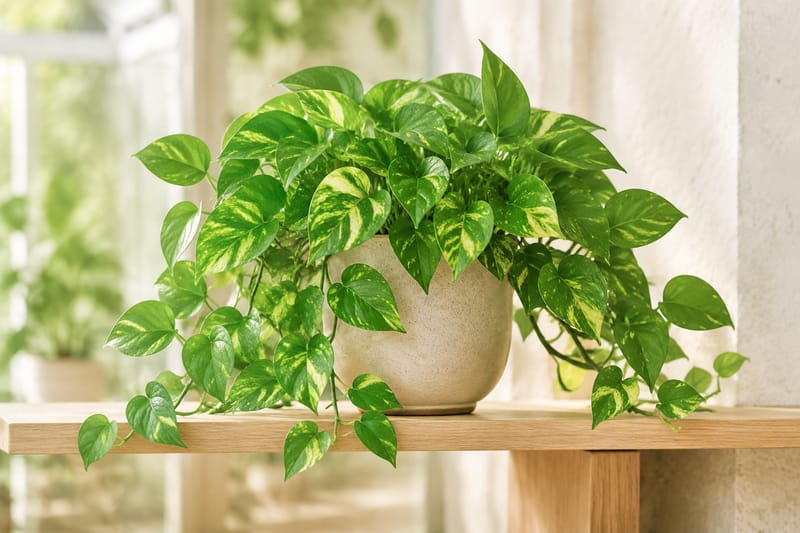
Pothos is an evergreen tropical climber grown indoors for its glossy, usually heart-shaped leaves and long leafy stems. Kew accepts Epipremnum aureum as the botanical name and records its native range as Mo'orea in the Society Islands. It has been cultivated and naturalized widely beyond that range, so a broad modern distribution should not be confused with its native origin.
Indoors, the plant can trail from a shelf or hanging container, or climb a support using aerial roots at its nodes. Most houseplants retain relatively small juvenile leaves. A supported vine in strong usable light can make larger growth over time, while a plant in dim conditions often produces longer gaps between leaves and weaker variegation.
Plant identification
Botanical characteristics
- Family
- Araceae
- Native range
- Society Islands (Mo'orea)
- Growth habit
- trailing evergreen vine
- Care level
- easy
- Common names
- Golden pothos, Devil's ivy
- Propagation
- Stem cuttings with at least one node, Layering
- Pet safety
- Toxic to cats and dogs if chewed or ingested
- Scientific synonyms
- Scindapsus aureus, Pothos aureus
Look for an evergreen vine with grooved leaf stalks, nodes that can produce aerial roots, and glossy leaves that are commonly heart-shaped in juvenile growth. Golden pothos usually carries yellow or cream variegation, but cultivars vary, so color alone is not enough for identification.
Common names include golden pothos and devil's ivy. Scindapsus aureus and Pothos aureus are scientific synonyms, not separate plant entities. Heartleaf philodendron can look similar, but it belongs to a different genus; use the leaf stalk, node and growth details rather than relying only on a common name.
Before you choose
Is this plant a good fit?
A good fit for
- Beginners who can check pot weight weekly
- Homes with bright indirect light
- Growers who want a trailing or climbing vine
Think twice if
- Homes where pets or children chew foliage
- Rooms with no usable natural or grow light
- Anyone who wants a fixed watering calendar
Care foundation
Care summary
Give bright indirect light, an airy mix, and water only after checking below the surface.
Detailed care
Read the conditions, not a calendar
Light
Place Pothos in bright, indirect light for compact growth and stronger variegation. It can persist in some shade, but lower light usually slows growth and may reduce variegation. Protect leaves from intense direct summer sun, which can leave pale, crisp scorch patches.
Move a plant gradually when increasing light. Judge the response from new leaves and the spacing between new nodes; existing stretched growth or faded variegation will not reverse immediately.
Watering
Check the potting mix and pot weight instead of watering on a fixed weekday. Water when the upper mix is approaching dryness, then wet the rootball thoroughly and let excess water leave the drainage holes. Empty water held inside a saucer or decorative cachepot.
A pot that remains heavy while several leaves yellow needs a drainage and root-zone check, not more water. A very light pot with dry mix below the surface is a better watering signal than a single drooping leaf, because leaf posture can also change with heat, root damage or stem injury.
Soil and pot
Use an airy houseplant mix that holds some moisture but drains freely. The container needs open drainage holes and should be only modestly larger than the rootball when repotting. A large volume of unused wet mix can stay saturated longer than the roots can safely use it.
Repot when roots have crowded the container or drainage has become difficult, rather than following an automatic annual schedule. Keep the plant at its previous planting depth and check that water can move through the new mix evenly.
Temperature and humidity
RHS guidance places Epipremnum in warm household conditions, ideally about 18–30°C (65–86°F), away from cold drafts and direct radiator heat. Normal household humidity is usually workable; high humidity does not compensate for poor light or saturated roots.
Watch how quickly the pot dries as seasons and room conditions change. Cooler, darker periods slow water use, while warmer and brighter conditions can shorten the interval between checks.
Getting established
Your first 30 days
- 01
Days 1–3: choose a stable bright-indirect placement and learn the pot weight.
- 02
Week 1: check the mix below the surface before watering.
- 03
Week 2: diagnosis: record vine direction, leaf color, and new growth.
- 04
Weeks 3–4: comparison of evidence supports one measured adjustment because multiple changes obscure the response; repeat these observation steps before a second adjustment.
Growth and maintenance
Support the way it grows
Feeding
Feed lightly during active growth according to the fertilizer label. Do not use fertilizer to correct stretched vines, fading variegation or persistently wet soil; correct light and root-zone conditions first. Reduce feeding when growth slows.
Support and aerial roots
Let stems trail or guide them onto a stable pole or trellis. Aerial roots form at nodes and can help a climbing stem attach. Pruning just above a node can shorten a long vine and encourage growth from another node; healthy cut sections with at least one node can be used for propagation.
Repotting and pruning
Stem cuttings root from nodes, not from a detached leaf blade alone. Use clean tools, keep cuttings in bright indirect light, and avoid leaving newly rooted cuttings in an oversized wet container.
Read the plant
Growth signals and practical checks
Healthy growth
- New leaves open without brown margins.
- Vines stay firm between waterings.
- The pot dries at a predictable pace.
Warning signs
- Soft stems or a sour potting mix need prompt root inspection.
- Rapid yellowing across several vines is not normal aging.
- Crisp pale patches on exposed leaves can signal sun scorch.
Common mistakes
- Common mistake: watering every Sunday without checking the root zone.
- Common mistake: placing a variegated type in a dark corner.
- Leaving water inside a decorative cachepot.
Practical notes
- Practical tip: use the same pot-weight test before every watering.
- Expert tips: prune just above a node to encourage branching and save healthy cuttings.
Safety
Toxicity and safety
Pothos is not pet-safe. The ASPCA lists Epipremnum aureum as toxic to cats and dogs because it contains insoluble calcium oxalates; reported signs include oral irritation, drooling, vomiting and difficulty swallowing. Keep the plant out of reach of pets and children, wear gloves if the sap irritates your skin, and contact a veterinarian or poison-control service after a concerning exposure.
Observation
Problems and observation
Check first
Yellowing, brown patches and limp vines are signals to inspect conditions, not diagnoses by themselves. Start with pot moisture and drainage, then check light at leaf level, stem firmness and the pattern of damage across old and new growth.
Observe
- Several yellow leaves with a heavy pot: pause watering and inspect drainage and roots.
- Long gaps between leaves or fading variegation: increase indirect light gradually.
- Pale crisp patches on the exposed side: review direct sun and heat exposure.
- Soft stems or a sour-smelling mix: inspect the root system promptly for decay.
Safe next action
Compare more than one signal before acting. Record pot weight, moisture below the surface, new-leaf size and node spacing, then change one condition at a time. Existing damaged leaves will not repair, so use subsequent growth and a more predictable drying pattern to judge recovery.
04Open a related diagnosis
Frequently asked questions
Is Pothos toxic to pets?
Pothos contains calcium oxalate crystals and should be kept away from pets and children who may chew it.
Can Pothos grow in low light?
It can survive in lower indirect light, but growth slows and variegation can fade; improve light before adding fertilizer.