
Plant profile
Dracaena trifasciata
Snake Plant
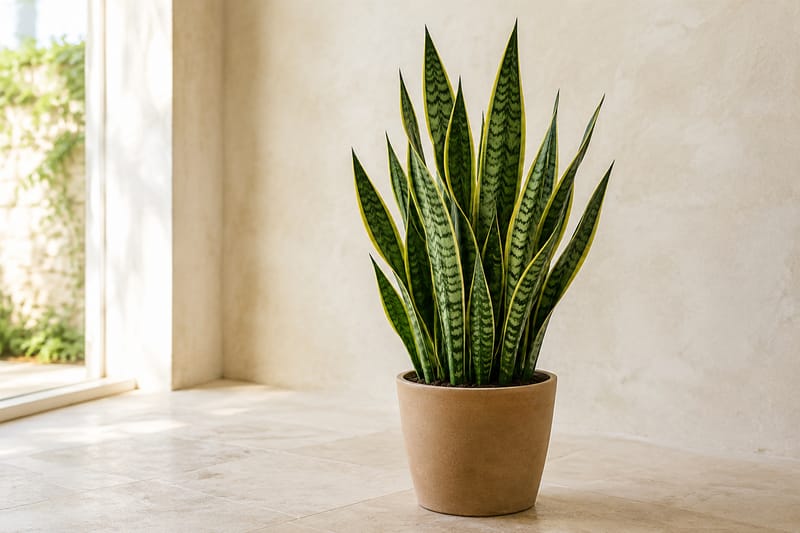
Identify Snake Plant by its upright leaves and rhizomatous growth, then review its essential indoor care, safety and warning signs.
Light
bright indirect
Water
Let root zone dry
Soil
Fast draining
Temperature
65–85°F (18–29°C)
Plant dossier
Plant overview
Snake Plant is a rhizomatous, drought-adapted evergreen grown for clusters of stiff upright leaves. Kew accepts Dracaena trifasciata as the current botanical name and treats Sansevieria trifasciata as a synonym. Its native range extends from southern Nigeria through west-central tropical Africa, with Tanzania also included in Kew's distribution record.
The plant stores water in fleshy leaves and spreads gradually from underground rhizomes. This explains two important indoor behaviors: it tolerates a dry root zone better than prolonged wetness, and new growth often appears as a separate pup beside the older leaf cluster rather than as a new branch above the pot.
Plant identification
Botanical characteristics
- Family
- Asparagaceae
- Native range
- Southern Nigeria to west-central tropical Africa and Tanzania
- Growth habit
- upright rhizomatous evergreen
- Care level
- easy
- Common names
- Mother-in-law's tongue, Golden bird's nest, Good luck plant
- Propagation
- Rhizome division, Offsets, Leaf cuttings
- Pet safety
- Toxic to cats and dogs if chewed or ingested
- Scientific synonym
- Sansevieria trifasciata
Look for a stemless-looking clump of thick, leathery leaves rising directly from the base. Leaves are usually flat, sword-shaped and patterned with horizontal green bands; cultivar margins and colors vary. Firm rhizomes anchor the clusters below the potting mix.
Common names include Snake Plant and Mother-in-law's Tongue. The older scientific name Sansevieria trifasciata remains common in horticulture and search, but it refers to the same plant entity as Dracaena trifasciata. Leaf shape and variegation differ among cultivars, so identify the growth habit as well as the pattern.
Before you choose
Is this plant a good fit?
A good fit for
- Beginners who prefer a drought-tolerant plant
- Rooms with bright indirect or moderate light
Think twice if
- Homes that water all plants on a weekly calendar
- Cold damp rooms without drainage
Care foundation
Care summary
Give Snake Plant a free-draining potting mix, a container with drainage and enough time for the root zone to dry between waterings. Bright indirect light supports steadier growth, although the plant can persist in lower light with slower water use and fewer new pups.
Detailed care
Read the conditions, not a calendar
Light
Use bright, lightly shaded or indirect light for balanced growth. Snake Plant tolerates lower light, but survival in a dim room does not mean the plant is actively growing. Strong midday sun introduced suddenly can scorch the foliage, so increase exposure gradually.
Watch the newest pup and the plant's lean. Rotate the pot periodically if growth consistently angles toward the light, while checking that a whole-plant collapse is not being mistaken for a simple light response.
Watering
Let the root zone dry thoroughly before watering again. Then water the mix evenly and allow all excess water to drain. Do not leave the container standing in runoff, and avoid pouring water repeatedly into the center of a tight leaf rosette.
Pot size, light, temperature and season determine how long drying takes. A heavy pot is a reason to wait. Soft leaf bases, unstable clusters or a persistently damp smell are reasons to inspect the roots and rhizomes before adding water.
Soil and pot
Use a fast-draining cactus or succulent-style mix with enough mineral structure to prevent compaction. Choose a pot with drainage holes and only modest extra room around the existing rhizomes. Snake Plants often remain stable in a close-fitting container; overpotting creates a larger wet volume around a compact root system.
Repot when rhizomes and roots crowd or distort the container, when drainage fails, or when the plant becomes unstable. Keep healthy rhizomes firm and discard decayed tissue with clean tools during a root inspection.
Temperature and humidity
RHS guidance places sansevierias in typical room temperatures around 15–24°C (60–75°F), with protection from cold drafts. They prefer lower household humidity and good air movement rather than misting or a persistently steamy position.
Cool, dim conditions sharply slow water use. During those periods, extend observation rather than following the watering interval used in warmer, brighter months.
Getting established
Your first 30 days
- 01
Days 1–7: choose stable light and check the pot has drainage.
- 02
Week 2: learn how dry the root zone becomes before watering.
- 03
Weeks 3–4: inspect leaf rigidity and pup growth before changing care.
Growth and maintenance
Support the way it grows
Feeding
Feed lightly during active growth according to the product label. Fertilizer is not a treatment for weak roots, soft leaves or slow growth in poor light. Correct drainage, temperature and light first, then feed only a healthy plant that is making new growth.
Support and aerial roots
Snake Plant does not need a climbing support. Remove only badly damaged leaves at the base with clean tools; a cut leaf does not regrow its missing tip. Divide firm rhizomes to make a true-to-type copy of a patterned cultivar.
Repotting and pruning
Leaf sections can also root, but RHS notes that variegated cultivars propagated from leaf cuttings may revert to green. Keep each section in its original top-to-bottom orientation and avoid overly wet propagation mix.
Read the plant
Growth signals and practical checks
Healthy growth
- Leaves remain stiff and upright.
- Rhizomes stay firm and new pups emerge gradually.
Warning signs
- Soft bases or mushy tissue need urgent root inspection.
- Sudden leaf collapse can indicate saturation, cold injury, or anchoring failure.
Common mistakes
- Watering while the lower mix is still wet.
- Using a deep oversized pot around compact rhizomes.
Practical notes
- Sansevieria trifasciata is a scientific/search synonym for this same entity.
- Division preserves patterned cultivars more reliably than leaf cuttings.
Safety
Toxicity and safety
Snake Plant is not pet-safe. The ASPCA lists it as toxic to cats and dogs and identifies saponins as the toxic principle, with nausea, vomiting and diarrhea among the reported signs. Keep it out of reach and contact a veterinarian or animal poison-control service after suspected ingestion. Wear gloves if damaged plant tissue irritates your skin.
Observation
Problems and observation
Check first
The relationship between leaf firmness and rhizome condition is more useful than a fixed watering schedule. Check whether symptoms affect one old leaf, an entire cluster or the newest growth, then inspect pot weight and root-zone moisture.
Observe
- Soft base or wobbling cluster: inspect roots and rhizomes for decay.
- Yellow leaves with wet mix: stop watering and review drainage.
- Crisp bleached patches: review sudden direct-sun exposure.
- Slow growth in low light: improve usable light before adding fertilizer or water.
Safe next action
Lift the pot, check moisture deeper than the surface and gently test whether each cluster is firmly anchored. Make one correction at a time. Recovery is shown by stable firm tissue and healthy new pups; damaged leaves may remain marked even after the underlying condition improves.
04Open a related diagnosis
Frequently asked questions
Is Sansevieria trifasciata the same as Snake Plant?
Yes. It is a historical scientific synonym used in search; it does not represent a separate plant entity.
How often should I water a Snake Plant?
Water only after the root zone has dried thoroughly, then adjust for light, temperature, and pot size rather than using a fixed schedule.