
Plant profile
Dracaena reflexa var. angustifolia
Madagascar Dragon Tree
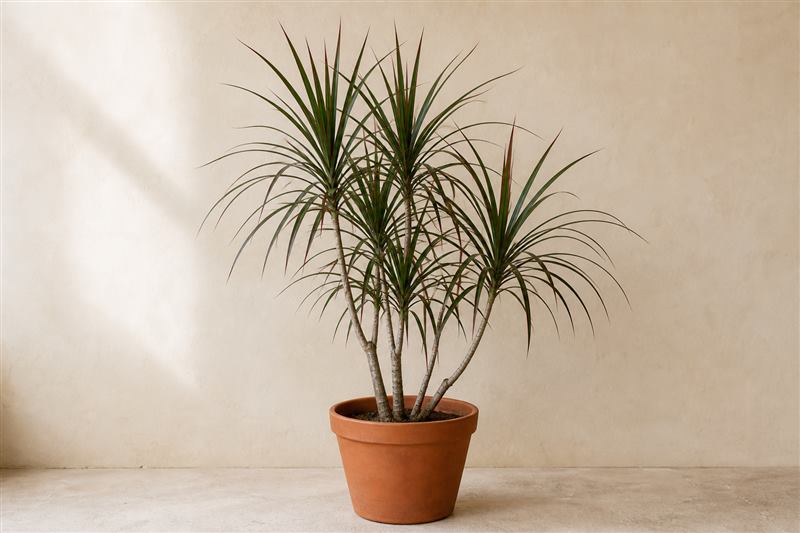
Identify Madagascar Dragon Tree by its slender ringed canes and narrow red-edged arching leaves, then coordinate light, dry-down, water quality, and root aeration.
Light
bright indirect light, with gradual acclimation to stronger exposure
Water
water after partial root-zone dry-down, then drain completely
Soil
structurally stable well-drained houseplant mix in a proportionate pot
Temperature
Warm, draft-free
Plant dossier
Plant overview
Madagascar Dragon Tree is the familiar horticultural Dracaena marginata. Kew accepts it as Dracaena reflexa var. angustifolia, an Asparagaceae shrub or tree native across western Indian Ocean islands. Indoors it develops slender woody canes topped by fountains of extremely narrow, pointed leaves.
Plant identification
Botanical characteristics
- Family
- Asparagaceae
- Native range
- Western Indian Ocean islands, including Madagascar, Mauritius, Réunion, Seychelles, Comoros, and neighboring archipelagos
- Growth habit
- slow-growing evergreen tropical shrub or tree with upright ringed canes and narrow recurved leaf crowns
- Care level
- straightforward when bright indirect light, measured dry-down, stable warmth, and low-salt inputs are maintained
- Common names
- Madagascar Dragon Tree, Dragon Tree, Red-marginated Dracaena, Straight-marginated Dracaena
- Propagation
- Top cuttings, Cane cuttings
- Pet safety
- ASPCA lists red-margined Dracaena as toxic to dogs and cats
- Scientific synonyms
- Dracaena marginata, Cordyline marginata, Pleomele marginata
Look for ringed gray-brown canes and crowded crowns of long, narrow, recurved dark-green leaves edged by a fine reddish-brown line. Do not merge it with Corn Plant (Dracaena fragrans), whose leaves are substantially broader, or with Lucky Bamboo, Dracaena sanderiana. Variegated marginata cultivars need their stripe pattern identified before discoloration is diagnosed.
Before you choose
Is this plant a good fit?
A good fit for
- Bright rooms needing a narrow upright plant
- Growers willing to observe cane and root evidence
- Spaces with stable warmth
Think twice if
- Homes where pets can chew reachable foliage
- Sealed decorative pots
- Cold drafty positions or harsh unacclimated sun
Care foundation
Care summary
Coordinate bright indirect light, partial root-zone dry-down, a stable draining mix, moderate humidity, conservative feeding, and a warm draft-free position. Map every change to its exact crown and cane before altering the shared root system.
Detailed care
Read the conditions, not a calendar
Light
Bright indirect light supports dense, balanced crowns. Lower light can produce sparse leaning growth; abrupt strong direct sun can leave fixed rust-tan scorch. Change exposure in stages and judge leaves produced after acclimation.
Watering
Water after partial dry-down through the occupied root zone, saturate evenly, and empty runoff. NC State and UF/IFAS note Dracaena sensitivity to fluoride, boron, and soluble salts. Brown tips therefore require a review of moisture, water source, fertilizer, and exposure rather than an automatic increase in watering.
Soil and pot
Use a stable, well-drained houseplant mix in a proportionate pot with a clear drainage hole. Do not bury cane bases for support. A very large container can keep unused mix wet long after the active roots have used their available moisture.
Temperature and humidity
Maintain stable indoor warmth with moderate humidity and gentle airflow. Protect every crown from cold transport, winter drafts, hot vents, and condensation against glass. Humidity supports leaf quality but cannot correct wet roots or remove established mites.
Getting established
Your first 30 days
- 01
Days 1–3: confirm narrow red-edged leaves, ringed canes, drainage, deeper moisture, and pet placement.
- 02
Week 1: record each crown and avoid watering until partial dry-down is verified.
- 03
Week 2: stabilize bright indirect light and protect from drafts.
- 04
Weeks 3–4: make one evidence-led correction and judge the next center leaves.
Growth and maintenance
Support the way it grows
Growth expectations
- Lower leaves release gradually as the cane becomes visible
- Pruned healthy canes can produce multiple new shoots below a cut
- Indoor flowering is uncommon
Seasonal changes
- Lower winter light slows dry-down
- Direct summer sun requires gradual acclimation
- Heating and cold glass create localized crown stress
Common mistakes
- Fixed weekly watering
- Keeping the plant in a dark corner
- Ignoring water and fertilizer salts
- Burying cane bases during repotting
Read the plant
Growth signals and practical checks
Healthy growth
- Firm ringed canes
- Dense crowns with narrow intact leaves
- Predictable moist-to-partly-dry root-zone cycle
Warning signs
- Soft dark cane base
- Loose cane with failed roots
- Rapid leaf loss after chilling
Common mistakes
- Fixed weekly watering
- Keeping the plant in a dark corner
- Ignoring water and fertilizer salts
- Burying cane bases during repotting
Practical notes
- Map every symptom to its exact crown and cane
- Compare new center leaves rather than expecting old tips to repair
Safety
Toxicity and safety
ASPCA lists red-margined Dracaena as toxic to cats and dogs. Position it out of reach, do not present it as pet-safe, and contact a veterinarian or animal poison service after suspected ingestion or concerning symptoms.
Observation
Problems and observation
Check first
Brown tips, yellowing, leaf loss, drooping, and sparse growth are observations rather than diagnoses. Record the affected crown, cane firmness, root-zone moisture, exposure boundary, and rate of change before selecting a problem path.
Safe next action
Photograph each crown from the same angle, mark pot weight after watering, probe the occupied root depth, and record vents, cold glass, and direct rays. Make one correction and compare the next center leaves with the baseline.
04Open a related diagnosis
Frequently asked questions
Is Dracaena marginata the accepted botanical name?
Kew treats Dracaena marginata as a synonym of the accepted Dracaena reflexa var. angustifolia; the older name remains common in horticulture.
Is Madagascar Dragon Tree the same as Corn Plant?
No. Corn Plant is Dracaena fragrans and has much broader leaves; this plant has extremely narrow leaves with fine reddish margins.
Is Dracaena marginata safe for cats and dogs?
No. ASPCA lists red-margined Dracaena as toxic to dogs and cats. Keep it inaccessible and contact a veterinarian after suspected ingestion or symptoms.
Will brown leaf tips become green again?
No. Correct the cause and evaluate leaves that develop afterward.