
Plant profile
Beaucarnea recurvata
Ponytail Palm
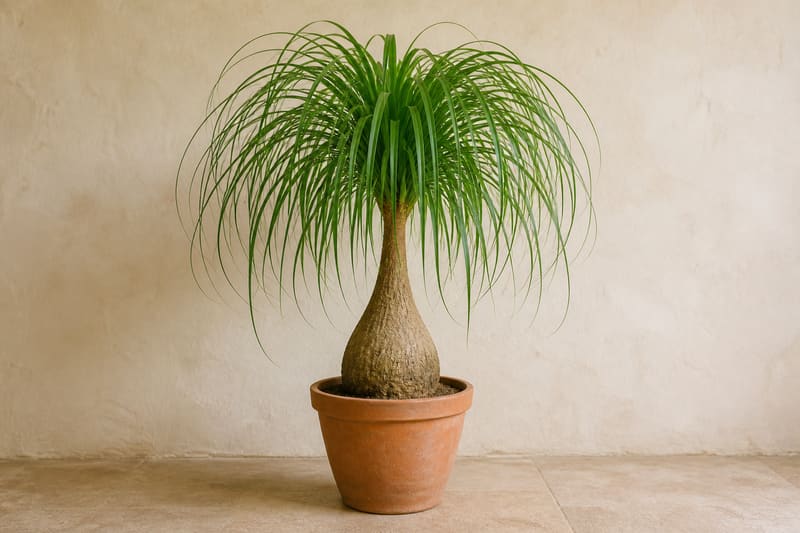
Identify Ponytail Palm by its swollen water-storing caudex and fountain of narrow recurving leaves, then coordinate bright light, complete dry-down, and seasonal warmth.
Light
strong light near a bright window
Water
allow complete root-zone dry-down, then water deeply and drain completely
Soil
coarse freely draining cactus-style mix in a modest pot with an open drainage hole
Temperature
frost-free stable warmth
Plant dossier
Plant overview
Beaucarnea recurvata is an accepted Asparagaceae species native to dry regions of Mexico. It is not a true palm. A swollen caudex stores water beneath a narrow trunk, and a rosette of tough strap-like leaves curves outward like a fountain. Container plants remain much smaller and slower than old landscape specimens.
Plant identification
Botanical characteristics
- Family
- Asparagaceae
- Native range
- Mexico, including Oaxaca, Puebla, San Luis Potosí, Tamaulipas, and Veracruz
- Growth habit
- slow-growing evergreen caudex tree commonly cultivated as a container houseplant
- Care level
- straightforward when strong light, complete dry-down, and frost protection are provided
- Common names
- Ponytail Palm, Bottle Palm, Elephant-foot Tree, Pony Tail Plant
- Propagation
- Seed under warm controlled conditions
- Pet safety
- ASPCA lists Beaucarnea recurvata as non-toxic to dogs, cats, and horses
- Scientific synonym
- Nolina recurvata
Look for a firm bulbous gray-brown base above the soil, a narrower trunk, and dense green leaves emerging from the top. Mature leaves are long, narrow, leathery, and naturally recurved. Do not confuse it with true palms, yuccas, or narrow-leaved Dracaena; the exposed swollen caudex is the strongest visible clue.
Before you choose
Is this plant a good fit?
A good fit for
- Bright indoor positions
- Growers who can wait for complete dry-down
- Drought-tolerant collections with open drainage
Think twice if
- Dim shelves
- Sealed decorative pots
- Frequent small watering
- Freezing locations
Care foundation
Care summary
Coordinate strong light, a coarse root zone, complete dry-down, full drainage, restrained feeding during active growth, and protection from frost. The caudex buffers drought but does not protect saturated roots.
Detailed care
Read the conditions, not a calendar
Light
Give the brightest practical indoor position. Strong light supports a dense crown and compact structure, but a plant raised in lower light needs gradual acclimation before direct sun. Dry pale patches on newly exposed tissue indicate injury rather than thirst.
Watering
Allow the root zone to dry thoroughly, then water across the entire mix and empty runoff. The caudex stores water, so repeated small drinks or a weekly schedule keep roots wet without benefiting the storage organ. Winter usually requires a much longer interval.
Soil and pot
Use a coarse cactus-style container mix and an open drainage hole. Keep the swollen base above the soil line. A modest stable pot limits excess wet mix while supporting the top-heavy crown; decorative outer pots must never trap runoff.
Temperature and humidity
Keep the plant frost-free and away from cold glass. Ordinary heated indoor air is suitable when light and drainage are sound; raising humidity is not a substitute for watering correctly. Outdoor summer exposure can improve light, but begin in protected bright shade and advance slowly.
Getting established
Your first 30 days
- 01
Days 1–3: confirm the caudex, crown, soil moisture, drainage, and window exposure.
- 02
Week 1: do not water until deep dry-down is verified; preserve the nursery baseline.
- 03
Week 2: increase light only in stages and record the natural arch of healthy leaves.
- 04
Weeks 3–4: make one evidence-based correction and judge central growth and caudex firmness.
Growth and maintenance
Support the way it grows
Growth expectations
- New narrow leaves emerge from the crown
- The swollen caudex enlarges slowly over years
- Container plants grow much more slowly and remain smaller than landscape specimens
Seasonal changes
- Winter dry-down takes longer
- Outdoor summer light requires gradual acclimation
- Plants must return indoors before frost
Common mistakes
- Calling natural recurving leaves wilted
- Watering weekly
- Burying the caudex
- Upsizing to a large wet pot
Read the plant
Growth signals and practical checks
Healthy growth
- A firm hard caudex
- Dense green central leaves
- Predictable complete root-zone dry-down
Warning signs
- A soft dark caudex beside wet soil
- Failed brown roots
- Rapid crown collapse
Common mistakes
- Calling natural recurving leaves wilted
- Watering weekly
- Burying the caudex
- Upsizing to a large wet pot
Practical notes
- Use pot weight and a deep probe together
- Photograph the caudex outline and central crown to measure slow change
Safety
Toxicity and safety
ASPCA lists Pony Tail as non-toxic to dogs, cats, and horses. That classification does not make plant chewing desirable; long leaves and potting media can still cause physical or digestive problems.
Observation
Problems and observation
Check first
Brown tips, yellow leaves, leaf loss, slow growth, and downward-curving foliage are observations rather than diagnoses. Map leaf age, tissue firmness, deep moisture, caudex condition, roots, exposure history, and pest evidence before intervening.
Safe next action
Record pot weight, deep soil moisture, caudex firmness, central crown density, and the direction of window exposure. Photograph the same view monthly because this species grows slowly and short-term impressions can be misleading.
04Open a related diagnosis
Frequently asked questions
Is Ponytail Palm a true palm?
No. Beaucarnea recurvata is in Asparagaceae and forms a swollen water-storing caudex rather than a true palm trunk.
Is Ponytail Palm safe for cats and dogs?
ASPCA lists Beaucarnea recurvata as non-toxic to dogs and cats, but chewing plants can still cause mechanical or digestive upset.
Why do healthy Ponytail Palm leaves bend downward?
Long narrow recurving leaves naturally form a fountain-shaped crown; loss of firmness or collapse is a separate signal.
Can I root a shoot removed from the caudex?
Do not count on it. Wisconsin Extension states that these apparent offsets do not root into new plants; seed is the dependable propagation route.