
Plant profile
Aloe vera
Aloe Vera
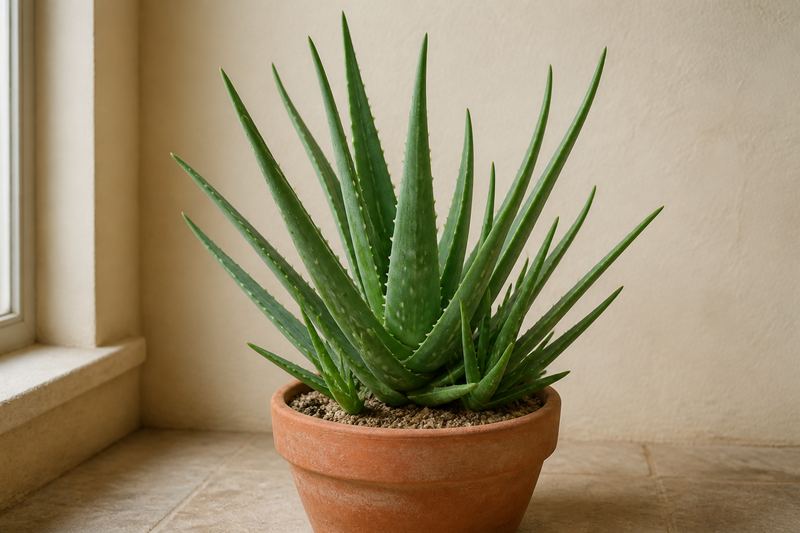
Identify Aloe vera by its stemless rosette, thick grey-green toothed leaves, offsets, and dry-growing root system, then make care decisions from light, leaf texture, and soil dry-down.
Light
strong light near a bright window
Water
soak the root zone after it dries, then drain completely
Soil
coarse well-draining cactus or succulent mix in a pot with an open drainage hole
Temperature
protect from freezing and cold wet conditions
Plant dossier
Plant overview
Aloe vera is an accepted succulent species in Asphodelaceae, native according to Kew to northern Oman and now cultivated worldwide. It forms a short-stemmed basal rosette of water-storing leaves and commonly produces offsets. This profile covers the living plant; it does not provide medical, cosmetic, or ingestion advice.
Plant identification
Botanical characteristics
- Family
- Asphodelaceae
- Native range
- Northern Oman; widely cultivated and naturalized in dry regions
- Growth habit
- evergreen succulent perennial forming a basal rosette and offsets
- Care level
- straightforward when strong light, complete dry-down, and frost protection are provided
- Common names
- Aloe Vera, True Aloe, Barbados Aloe, Medicinal Aloe
- Propagation
- Division of rooted offsets, Seed under controlled conditions
- Pet safety
- ASPCA lists true aloe as toxic to dogs and cats when ingested
- Scientific synonyms
- Aloe barbadensis, Aloe perfoliata var. vera
Look for thick grey-green lance-shaped leaves rising from a dense rosette, small pale teeth along the margins, occasional light mottling on younger leaves, and offsets at the base. Do not identify every spotted rosette succulent as Aloe vera: Haworthiopsis, Gasteria, Agave, and other Aloe species require separate evidence.
Before you choose
Is this plant a good fit?
A good fit for
- Bright sunny windows
- Growers who allow full soil dry-down
- Succulent collections with open drainage
Think twice if
- Dim shelves
- Containers without drainage
- Homes where pets can chew accessible leaves
Care foundation
Care summary
Coordinate strong light, gradual sun acclimation, a coarse draining mix, deep but infrequent watering, conservative feeding during active growth, and protection from frost.
Detailed care
Read the conditions, not a calendar
Light
Aloe vera needs stronger indoor light than many foliage houseplants. Place it near a bright window, rotate after it adapts, and introduce direct exposure gradually. Stretched pale growth indicates insufficient light; dry straw-colored patches after a move support scorch.
Watering
Allow the root zone to dry before watering thoroughly, then empty runoff. Succulent leaves store water, so the plant usually needs a longer interval than thin-leaved houseplants. Reduce frequency when winter light and temperature slow growth.
Soil and pot
Use a coarse cactus or succulent mix with reliable drainage. A large pot or dense garden soil holds water around roots too long. Keep the rosette base above the soil line and the drainage hole open.
Temperature and humidity
Protect container plants from freezing. When moving outdoors, begin in bright shade and increase sun exposure gradually. Cold wet roots and abrupt hot sun are separate risks and leave different evidence.
Getting established
Your first 30 days
- 01
Days 1–3: confirm the Aloe vera rosette, record soil moisture, drainage, leaf texture, and window exposure.
- 02
Week 1: do not water until the root zone is dry; verify that the pot can drain.
- 03
Week 2: move toward stronger light only in stages and preserve the original leaf pattern.
- 04
Weeks 3–4: make one evidence-based correction and judge the next central leaf.
Growth and maintenance
Support the way it grows
Growth expectations
- New leaves emerge from the rosette center
- Mature plants form offsets around the base
- Established plants may produce a tall stalk of tubular yellow or orange flowers
Seasonal changes
- Short cool days extend dry-down
- Outdoor summer light requires gradual acclimation
- Containers must return indoors before frost
Common mistakes
- Watering on a weekly calendar
- Keeping the plant on a dim shelf
- Using a sealed decorative pot
- Trying to propagate a detached leaf
Read the plant
Growth signals and practical checks
Healthy growth
- Firm broad central leaves
- Predictable full wet-to-dry soil cycle
- Rooted offsets developing without a soft parent base
Warning signs
- A soft dark rosette base
- A loose plant in persistently wet soil
- Rapidly expanding wet leaf lesions
Common mistakes
- Watering on a weekly calendar
- Keeping the plant on a dim shelf
- Using a sealed decorative pot
- Trying to propagate a detached leaf
Practical notes
- Use pot weight and a wooden probe to verify deeper dry-down
- Compare the width and spacing of new central leaves with older compact growth
Safety
Toxicity and safety
ASPCA lists true aloe as toxic to dogs and cats when ingested. Keep the plant inaccessible to pets that chew leaves and contact a veterinarian or animal poison service when exposure causes concern. This page does not recommend ingesting or applying plant material.
Observation
Problems and observation
Check first
Yellow leaves, soft tissue, brown tips, leaning, and spots are observations. Map their position, texture, and spread, then compare the root zone, light direction, and recent watering before diagnosing.
Safe next action
Record pot weight, deeper soil moisture, leaf firmness, central leaf width, rosette symmetry, and the exact window exposure. Change one variable and use the next central leaf as the response.
04Open a related diagnosis
Frequently asked questions
Is Aloe barbadensis a different plant from Aloe vera?
Kew treats Aloe barbadensis as a synonym of the accepted name Aloe vera.
Is Aloe vera safe for cats and dogs?
No. ASPCA lists true aloe as toxic to dogs and cats when ingested; contact a veterinarian when exposure causes concern.
Can Aloe vera grow in low light?
It may survive temporarily, but compact healthy indoor growth needs strong usable light and often some carefully acclimated sun.
Can a cut Aloe vera leaf grow a new plant?
A detached leaf is not a reliable propagation method. Separate a well-developed rooted offset instead.