
Plant profile
Spathiphyllum wallisii
Peace Lily
Identify Peace Lily by its glossy clumping leaves and white spathes, then use root-zone, light, flowering and safety signals to guide indoor care.
Light
bright filtered or indirect
Water
keep evenly moist without leaving the root zone soggy
Soil
moisture-retentive but freely draining houseplant mix
Temperature
68–85°F (20–29°C) in active indoor growth
Plant dossier
Plant overview
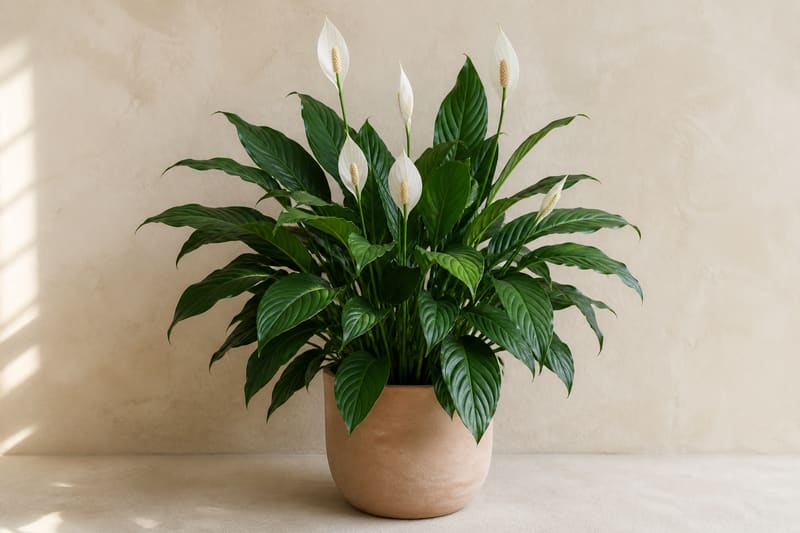
Peace Lily is a clump-forming tropical aroid grown indoors for glossy, lance-shaped foliage and upright white spathes. This profile uses Spathiphyllum wallisii as the canonical species identity. Kew accepts that name and records its native range from Colombia to Venezuela. The broader genus contains many species and cultivated selections, so a retail label that says only “Spathiphyllum” may not identify a cultivar or species with certainty.
Its white structure is not a single lily petal. It is a modified leaf called a spathe wrapped around a central spadix that bears the small flowers. That distinction matters for identification and prevents the common name from being confused with true lilies.
Plant identification
Botanical characteristics
- Family
- Araceae
- Native range
- Colombia to Venezuela
- Growth habit
- clump-forming evergreen herbaceous perennial
- Care level
- moderate
- Common names
- Peace lily, White sails, Spathe flower
- Propagation
- Division of established clumps
- Pet safety
- Toxic to cats and dogs if chewed or ingested
Look for leaves rising in a basal clump rather than along a climbing vine. Healthy foliage is glossy, dark green and strongly veined, with an elongated blade that narrows toward the tip. Flowering stems rise above or through the foliage and carry a pale spadix backed by a white spathe that can turn greener as it ages.
Do not identify the plant from flower color alone. Anthuriums and other aroids also produce a spathe and spadix. Peace Lily combines that flower structure with an unarmed, clumping habit and leaves that arise on individual stalks from the crown.
Before you choose
Is this plant a good fit?
A good fit for
- Rooms with bright filtered light
- Growers who can monitor moisture instead of using a calendar
- People who want a compact flowering foliage plant
Think twice if
- Homes where pets or children chew foliage
- Direct-sun windows without screening
- Growers who cannot empty standing runoff
Care foundation
Care summary
Use bright filtered light, a draining but moisture-retentive mix and condition-based watering. Keep the plant warm, protect it from direct sun and cold drafts, and feed lightly only during active growth.
Detailed care
Read the conditions, not a calendar
Light
Bright indirect or filtered light supports compact foliage and flowering. Peace Lily can maintain foliage in lower light, but survival tolerance is not the same as flowering performance. Deep shade can reduce blooms, while direct summer sun can bleach or scorch exposed tissue.
Assess light from the leaf position, not from the room entrance. If increasing light, move the plant in stages and use the next leaves and flower production as evidence. Existing scorch will not reverse.
Watering
Aim for an evenly moist root zone that is never left saturated. Check below the surface and lift the pot before watering. When the pot has become lighter and the upper root zone is no longer wet, water slowly until the root ball is evenly wetted and excess leaves the drainage holes.
Drooping can occur when the mix becomes too dry, but damaged roots can also leave foliage limp while the pot is wet. Always pair posture with pot weight and root-zone moisture before acting.
Soil and pot
Use a mix that retains some moisture yet contains enough coarse structure for air and drainage. The inner container needs open drainage holes. Repot only when roots have substantially occupied the container or the mix no longer wets and drains evenly; moving into an oversized volume of wet mix increases root-zone risk.
Temperature and humidity
Warm, stable indoor conditions suit Peace Lily. NC State and Missouri Botanical Garden describe active growth in roughly 68–85°F conditions. Protect the plant from cold drafts and abrupt temperature swings. Moderate humidity can support leaf quality, but extra humidity cannot correct saturated roots or inadequate light.
Getting established
Your first 30 days
- 01
Days 1–3: place the plant in bright filtered light and check the pot for drainage.
- 02
Week 1: learn how the pot feels after watering and as the root zone dries.
- 03
Week 2: record leaf posture, new growth and flower condition without changing several inputs.
- 04
Weeks 3–4: make one evidence-based adjustment and judge the next leaf or drying cycle.
Growth and maintenance
Support the way it grows
Growth expectations
- New leaves emerge from the basal clump rather than a climbing stem
- White spathes surround the small flowers on a central spadix
- Established clumps can be divided when several crowns and healthy roots are present
Seasonal changes
- Shorter cooler days usually slow water use
- Stronger spring window light may require a gradual placement adjustment
Common mistakes
- Treating every dramatic droop as proof that more water is always needed
- Keeping the inner pot in runoff inside a decorative container
- Expecting deep shade to support repeated flowering
Read the plant
Growth signals and practical checks
Healthy growth
- New leaves open upright and evenly green
- The root zone moves through a predictable moist-to-less-moist cycle
- Flower stalks and leaves remain firm without persistent collapse
Warning signs
- A heavy wet pot with yellowing and soft roots needs prompt inspection
- Black water-soaked lesions that continue spreading need isolation and diagnosis
- Mouth irritation after chewing requires veterinary or poison-control advice
Common mistakes
- Treating every dramatic droop as proof that more water is always needed
- Keeping the inner pot in runoff inside a decorative container
- Expecting deep shade to support repeated flowering
Practical notes
- Use pot weight together with root-zone moisture because leaf posture alone has several causes
- Judge recovery from stable new growth because damaged yellow or brown tissue will not become green again
Safety
Toxicity and safety
Peace Lily is not pet-safe. ASPCA attributes its toxicity to insoluble calcium oxalates and lists oral irritation, drooling, vomiting and difficulty swallowing among possible signs in cats and dogs. Keep it out of reach, wash sap from skin, and contact a veterinarian or poison-control service after a concerning exposure. Peace Lily should not be confused with true Lilium lilies, but that distinction does not make it safe to chew.
Observation
Problems and observation
Check first
Yellow leaves, brown tips, curling and drooping are observations rather than diagnoses. Map where damage starts, check whether the pot is wet or dry, note recent light changes, and inspect roots when moisture and posture conflict. Old damaged tissue is not the recovery measure; stable new leaves are.
Safe next action
Record four signals together: pot weight, moisture below the surface, leaf posture and the condition of the newest leaf. Photograph a spreading pattern from the same angle. Make one correction, then review the next drying cycle before changing another variable unless household safety or active rot requires immediate action.
04Open a related diagnosis
Frequently asked questions
Is a Peace Lily a true lily?
No. Peace lilies belong to the arum family, Araceae; their white display is a spathe surrounding a spadix rather than a true lily flower.
Is Peace Lily safe for cats and dogs?
No. ASPCA lists Spathiphyllum as toxic to cats and dogs because chewing can release insoluble calcium oxalates and cause oral irritation, drooling, vomiting or difficulty swallowing.
Which Peace Lily cultivars are commonly sold?
Retail plants may include compact Wallisii types, variegated Domino or Gemini selections, and much larger Sensation plants; use a cultivar label rather than appearance alone when exact identity matters.
When should I repot a Peace Lily?
Repot when roots crowd the drainage holes or surface, the plant becomes unstable, or the mix no longer wets and drains predictably—not simply because a calendar interval has passed.