
Plant profile
Syngonium podophyllum
Arrowhead Plant
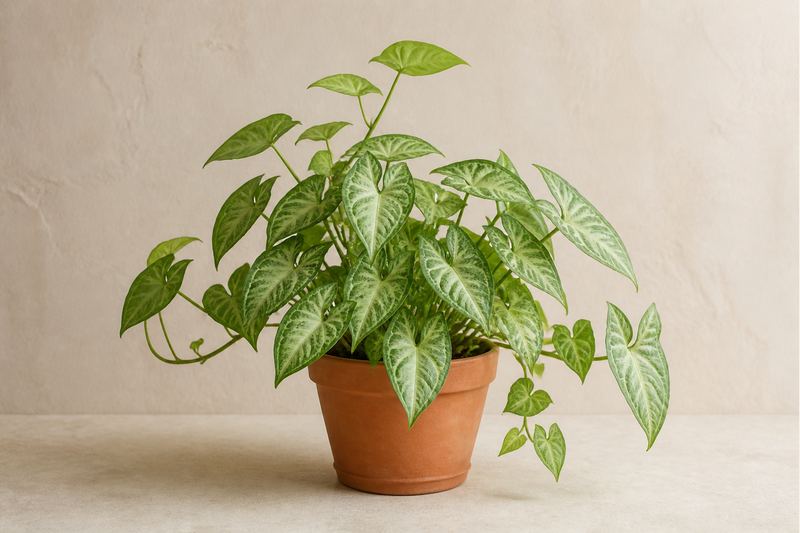
Identify Arrowhead Plant by its juvenile arrow-shaped leaves, sheathing petioles, node-bearing climbing stems, aerial roots, and mature divided foliage, then coordinate filtered light, drainage, pruning, support, and pet safety.
Light
Bright indirect light for green forms and bright filtered light for variegated forms, protected from intense direct sun
Water
Water after the upper root zone begins to lose moisture and the pot becomes lighter, then drain completely and never retain water in a cachepot
Soil
Loose moisture-retentive but freely draining houseplant compost in a proportional container with an unobstructed drain
Temperature
Stable warm indoor conditions, with RHS advising at least 15°C in winter and protection from cold glass, exterior doors, and hot forced air
Plant dossier
Plant overview
Arrowhead Plant is Syngonium podophyllum, an evergreen aroid liana native from Mexico through tropical America. The familiar compact houseplant is its juvenile phase; with time, the stem lengthens, roots at nodes, and seeks support.
Plant identification
Botanical characteristics
- Family
- Araceae
- Native range
- Mexico through tropical America
- Growth habit
- evergreen tropical liana with succulent node-bearing stems, aerial roots, juvenile arrow-shaped leaves, and progressively divided mature foliage
- Care level
- Moderate because the vine is adaptable indoors but needs filtered light, a drainable root zone, deliberate shape management, and protection from cold and chewing pets
- Common names
- Arrowhead Plant, Arrowhead Vine, American Evergreen, Nephthytis
- Propagation
- Stem cuttings containing viable nodes, Tip cuttings, Layering
- Pet safety
- Toxic to dogs, cats, and horses according to ASPCA because it contains insoluble calcium oxalates; prevent chewing and contact a veterinarian or animal poison service after suspected ingestion
- Scientific synonym
- Pothos auritus
Juvenile leaves are simple and arrow-shaped on long sheathing petioles. Follow a petiole to a fleshy green node-bearing stem, where buds and aerial roots may form. As a vine matures, intermediate leaves develop lobes and adult leaves can divide into several finger-like sections.
Before you choose
Is this plant a good fit?
A good fit for
- Bright rooms with filtered light
- Growers who enjoy pruning or training vines
- Shelves with intentional trailing space
- Indoor plant collections kept away from pets
Think twice if
- Homes where pets can chew foliage
- Cold drafty windows
- Pots without drainage
- Full-sun placement
- Owners expecting a permanently compact plant without pruning
Care foundation
Care summary
Coordinate bright filtered light, a loose drainable root zone, stable warmth, moderate feeding during active growth, and a deliberate mature form. Light and temperature change both internode length and water use.
Detailed care
Read the conditions, not a calendar
Light
Green forms tolerate bright indirect light; variegated forms retain pattern best with stronger filtered light. Deep shade can lengthen internodes, while intense direct rays can bleach or scorch the blade. Judge placement from leaves produced after the move.
Watering
Inspect the upper mix and pot weight. Water the occupied root ball evenly, let excess leave, and empty the outer pot. Natural trailing posture is not a watering trigger, and wilt above a wet pot requires root inspection.
Soil and pot
Use clean loose houseplant compost that retains useful moisture while releasing excess water. Follow root occupancy when sizing the container, and use a separate pole or trellis for canopy support instead of an oversized volume of wet mix.
Temperature and humidity
Maintain stable warmth; RHS advises at least 15°C in winter. Keep leaves away from cold panes, door drafts, radiators, and supply vents. Support humidity without keeping sheaths and blades continuously wet.
Getting established
Your first 30 days
- 01
Days 1–3: confirm Syngonium podophyllum; photograph juvenile leaves, petiole sheaths, nodes, aerial roots, stem base, roots, and container.
- 02
Week 1: map filtered light, direct rays, cold or hot drafts, pot weight, drainage, and pest evidence.
- 03
Week 2: learn one upper-dry-to-drained watering cycle and decide whether the vine will climb, trail, or remain compact through pruning.
- 04
Weeks 3–4: make one supported change and judge the next node, leaf expansion, stem firmness, and root-zone response.
Growth and maintenance
Support the way it grows
Growth expectations
- Juvenile plants carry simple arrow-shaped leaves
- Stems lengthen into vines and form aerial roots at nodes
- Intermediate and mature leaves can become lobed or divided
- Pruning above a viable node can redirect later shoots
Seasonal changes
- Lower winter light slows node extension and water use
- Heating can increase dry airflow around margins
- Brighter warm periods accelerate vine growth and direct-sun risk
Common mistakes
- Treating every long stem as decline
- Watering unsupported droop without checking the pot
- Placing variegated leaves in harsh sun
- Trying to propagate a detached leaf without a node
- Allowing pets to chew calcium-oxalate tissue
Read the plant
Growth signals and practical checks
Healthy growth
- Firm expanding blades
- Active nodes and intact petiole sheaths
- Sturdy internodes appropriate to the light
- Firm roots and stem base
- Predictable root-zone moisture use
Warning signs
- Persistent wilt over wet mix
- Soft lower stem or roots
- Rapid multi-leaf yellowing
- Enlarging water-soaked lesions
- Cottony colonies or fine webbing
Common mistakes
- Treating every long stem as decline
- Watering unsupported droop without checking the pot
- Placing variegated leaves in harsh sun
- Trying to propagate a detached leaf without a node
- Allowing pets to chew calcium-oxalate tissue
Practical notes
- Mark the newest node to measure growth
- Read petiole and stem posture separately
- Decide the desired mature form before pruning or support work
Safety
Toxicity and safety
ASPCA lists Arrowhead Vine as toxic to dogs, cats, and horses because of insoluble calcium oxalates. Sap and chewed tissue can cause oral irritation, swelling, drooling, vomiting, and difficulty swallowing. Prevent access and contact a veterinarian or animal poison service after suspected ingestion.
Observation
Problems and observation
Check first
Read each symptom by leaf age, blade surface, petiole, node, stem base, roots, pot moisture, and exposure. This separates normal leaf maturation and vine posture from root failure, stretch, leaf spot, or pests.
Safe next action
Mark the newest node, measure the next internode, photograph the same leaf surface, and record drained pot weight. Make one supported correction, then judge the next leaf rather than expecting old damage to disappear.
04Open a related diagnosis
Frequently asked questions
Why are Arrowhead Plant leaves changing shape?
Syngonium podophyllum normally changes from simple juvenile arrow-shaped leaves toward lobed or divided mature foliage as a supported vine develops.
Is Arrowhead Plant toxic to pets?
Yes. ASPCA lists it as toxic to dogs, cats, and horses because of insoluble calcium oxalates; prevent access and seek veterinary guidance after suspected ingestion.
Can a single Arrowhead Plant leaf be propagated?
A detached leaf and petiole are not enough; propagation requires a piece of stem containing at least one viable node.
Does Arrowhead Plant have to climb?
It naturally becomes a vine, but it can be trained upward, allowed to trail, or pruned periodically for a more compact form.