
Plant profile
Dieffenbachia seguine
Dieffenbachia
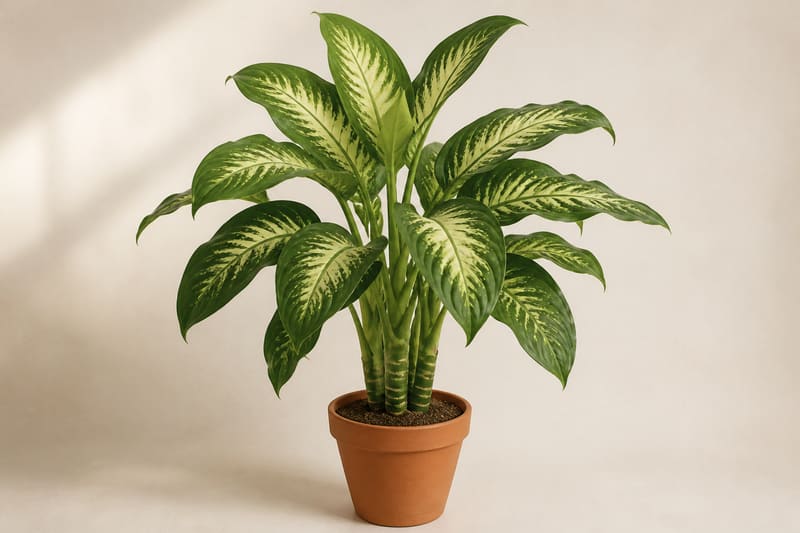
Identify Dieffenbachia seguine by its upright cane, broad cream-variegated leaves, and sheathing petioles, then coordinate filtered light, measured watering, warmth, drainage, and safe handling.
Light
bright filtered or indirect light for compact variegated growth
Water
water thoroughly after the upper inch and pot weight show demand, then drain completely
Soil
fertile peat-free container mix that retains distributed moisture while preserving durable root air
Temperature
Warm, draft-free
Plant dossier
Plant overview
Dieffenbachia is an upright tropical aroid grown for large glossy leaves patterned in green, cream, white, or yellow. Kew accepts Dieffenbachia seguine, a variable species native from the Caribbean into tropical South America.
Plant identification
Botanical characteristics
- Family
- Araceae
- Native range
- Caribbean through northern and tropical South America
- Growth habit
- upright evergreen tropical subshrub with cane-like stems and broad variegated leaves
- Care level
- moderate; adaptable to filtered indoor light but sensitive to saturation, cold drafts, and unsafe sap handling
- Common names
- Dieffenbachia, Dumb Cane, Dumbcane, Spotted Dumb Cane, Variable Dieffenbachia
- Propagation
- Stem-tip cuttings, Cane sections containing viable nodes, Air layering
- Pet safety
- ASPCA lists Dieffenbachia as toxic to dogs and cats because insoluble calcium oxalates can cause oral irritation, drooling, vomiting, and difficulty swallowing; seek veterinary guidance after exposure
- Scientific synonyms
- Dieffenbachia amoena, Dieffenbachia maculata, Dieffenbachia picta
Look for a firm cane-like stem marked by old leaf scars, sheathing petiole bases, and broad oval-to-oblong blades with irregular pale patterning. New leaves emerge tightly from the crown and then flatten. Cultivars vary, so pattern alone cannot resolve every plant.
Before you choose
Is this plant a good fit?
A good fit for
- Warm rooms with bright filtered light
- Growers who monitor pot weight and drainage
- Spaces that can accommodate upright cane growth
Think twice if
- Homes where children or pets can chew accessible foliage
- Cold drafty positions
- Containers without drainage
- Handling without sap precautions
Care foundation
Care summary
Coordinate bright filtered light, a measured upper-inch and pot-weight watering trigger, freely aerated soil, stable warmth, moderate humidity, and safe handling whenever plant tissue is cut or damaged.
Detailed care
Read the conditions, not a calendar
Light
Bright filtered or indirect light supports compact growth and clear pattern. Lower light can lengthen internodes and reduce variegation; abrupt hot sun can create bounded pale injury. Evaluate the newest leaf and direction of lean.
Watering
Check the upper inch, a deeper point, and pot weight. Water the occupied zone thoroughly when demand is confirmed, then remove runoff. Do not let a visually firm cane hide persistent wetness below the surface.
Soil and pot
Use a fertile peat-free mix with durable air spaces and an open drain. Keep the cane at its established depth and increase pot size modestly so unused mix does not remain saturated around a small root system.
Temperature and humidity
Maintain stable indoor warmth above 15°C and protect leaves from cold glass, doors, heaters, and air-conditioner streams. Useful humidity supports broad foliage, but continuously wet leaves and stagnant air create different risks.
Getting established
Your first 30 days
- 01
Days 1–3: confirm Dieffenbachia seguine, photograph cane firmness and variegation, inspect both leaf surfaces, and verify drainage.
- 02
Week 1: map direct-light boundaries, cold drafts, child and pet access, and existing spots or tip damage.
- 03
Week 2: learn pot weight, upper-inch dryness, deeper moisture, and drain time without feeding or repotting automatically.
- 04
Weeks 3–4: make one supported adjustment and judge the next crown leaf and internode.
Growth and maintenance
Support the way it grows
Growth expectations
- New leaves unfurl from the upright crown
- Firm canes develop visible leaf scars as lower leaves age
- Adequate filtered light supports compact internodes and distinct variegation
Seasonal changes
- Warm bright growth increases moisture use
- Cooler lower-light periods slow demand
- Winter drafts can cause localized yellowing and droop
Common mistakes
- Assuming low-light tolerance means a dark corner is optimal
- Watering on a fixed weekday
- Burying the cane deeper to correct instability
- Handling sap or cuttings without gloves
Read the plant
Growth signals and practical checks
Healthy growth
- Firm upright cane
- New leaves opening without distortion
- Pale functional roots
- Stable variegation and compact crown growth
Warning signs
- Soft dark cane base
- Persistent wetness with failed roots
- Expanding wet-looking lesions
- Confirmed stippling and webbing
- Concerning human or pet exposure
Common mistakes
- Assuming low-light tolerance means a dark corner is optimal
- Watering on a fixed weekday
- Burying the cane deeper to correct instability
- Handling sap or cuttings without gloves
Practical notes
- Use internode length and the newest leaf to judge current light
- Air-layer or root a firm top before shortening a tall healthy cane
Safety
Toxicity and safety
Dieffenbachia contains irritating calcium oxalate structures. Exposure can cause painful mouth, skin, or eye irritation; ASPCA lists the plant as toxic to dogs and cats. Keep it inaccessible, use gloves for cutting, and contact Poison Control or a veterinarian after a concerning exposure.
Observation
Problems and observation
Check first
Map every change to leaf age, crown growth, one exposure side, the whole cane, or the root zone. Pair that distribution with pot weight, moisture duration, root and cane firmness, light, temperature, airflow, and confirmed pest evidence.
Safe next action
Photograph the complete plant, three marked leaves, the newest crown leaf, lower cane, pot, and exposure side. Record upper-inch dryness, deeper moisture, container weight, drain time, internode length, temperature, airflow, and both leaf surfaces before changing one variable.
04Open a related diagnosis
Frequently asked questions
Is Dieffenbachia toxic to pets?
Yes. ASPCA lists it as toxic to dogs and cats because insoluble calcium oxalates can cause painful oral and gastrointestinal signs.
Can Dieffenbachia sap irritate people?
Yes. Poison Control documents irritation of skin, eyes, and oral tissue; wear gloves for cutting and seek expert help after concerning exposure.
Can Dieffenbachia grow in low light?
It can tolerate lower light, but compact growth and stronger variegation usually need useful filtered light.
Can a Dieffenbachia leaf cutting grow a new plant?
A leaf alone is not enough; use a stem tip or cane section containing a viable node, or use air layering.