
Plant profile
Goeppertia orbifolia
Calathea Orbifolia
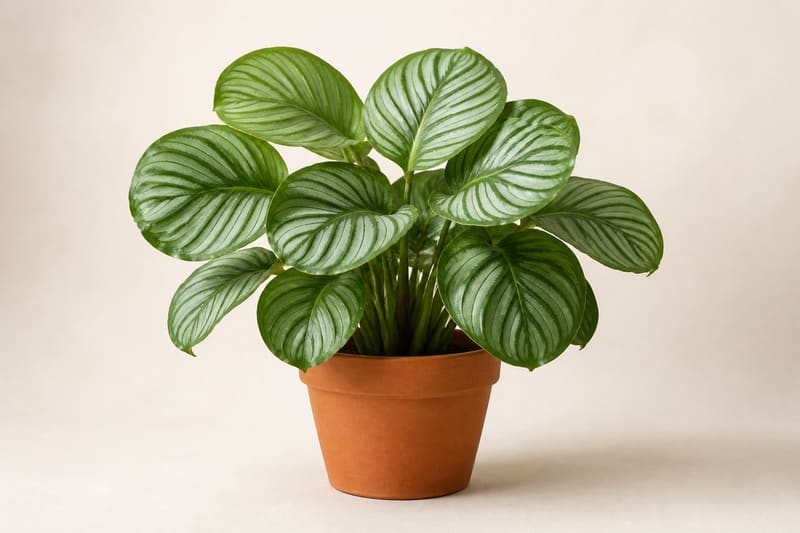
Identify Calathea Orbifolia by its large round silver-striped leaves and rhizomatous clump, then coordinate filtered light, even moisture, humidity, warmth, and drainage.
Light
bright indirect or filtered
Water
keep evenly moist during active growth without saturation, then reduce frequency as cooler lower-light demand slows
Soil
moisture-retentive but freely aerated peat-free container mix with unobstructed drainage
Temperature
Warm, draft-free
Plant dossier
Plant overview
Calathea Orbifolia is Goeppertia orbifolia, an accepted eastern Brazilian evergreen rhizomatous plant grown for large nearly round leaves marked with broad pale silver-green bands.
Plant identification
Botanical characteristics
- Family
- Marantaceae
- Native range
- Eastern Brazil
- Growth habit
- evergreen rhizomatous tropical perennial with a clump-forming habit and large nearly round silver-striped leaves
- Care level
- moderate to demanding because broad thin leaves need stable filtered light, warmth, humidity, even moisture, and root aeration
- Common names
- Calathea Orbifolia, Round-leaved Calathea, Orbifolia Prayer Plant
- Propagation
- Division of established rooted rhizomes
- Pet safety
- ASPCA lists Calathea species as non-toxic to dogs, cats, and horses; non-toxic does not mean that chewing foliage or potting mix is desirable
- Scientific synonyms
- Calathea orbifolia, Maranta orbifolia, Calathea rotundifolia
Look for a dense clump of long petioles rising from rhizomes and supporting very broad round-to-oval green leaves. The pale bands follow the side veins from the midrib. New leaves rise as tight vertical rolls and expand from the center.
Before you choose
Is this plant a good fit?
A good fit for
- Warm rooms with bright filtered light
- Humid plant groupings with air exchange
- Growers who monitor root moisture
- Spaces that can accommodate broad leaves
Think twice if
- Hot direct-sun windows
- Cold drafty rooms
- Very dry forced-air positions
- Containers without drainage
Care foundation
Care summary
Coordinate bright filtered light, stable warmth, useful humidity, evenly moist but aerated medium, reduced frequency during slower growth, and conservative feeding only while new leaves are extending.
Detailed care
Read the conditions, not a calendar
Light
Bright indirect or filtered light supports broad patterned leaves. Direct sun can bleach the exposed side, while insufficient light can reduce new leaf size. Evaluate the newest leaf and direction of growth rather than one old blade.
Watering
Check the surface, a deeper point, and pot weight. Water the complete occupied zone when demand is confirmed, then remove runoff. Avoid both severe dry-down and persistent saturation, which can produce similar curl or droop through different mechanisms.
Soil and pot
Use a peat-free mix that retains distributed moisture while maintaining durable air spaces. Keep the drain open, preserve crown depth, and increase pot size modestly only when roots occupy the container or the medium has failed.
Temperature and humidity
Maintain stable warmth, preferably around 16–24°C, with useful humidity and gentle air exchange. Keep foliage away from cold glass and direct heater, air-conditioner, or humidifier streams.
Getting established
Your first 30 days
- 01
Days 1–3: confirm Goeppertia orbifolia rather than another plant sold as Calathea, inspect both leaf surfaces, and verify drainage.
- 02
Week 1: photograph leaf pattern, the newest roll, existing edge damage, direct-light boundaries, drafts, humidity, and temperature.
- 03
Week 2: record pot weight, moisture depth, drain time, root condition, and opening progress.
- 04
Weeks 3–4: make one supported adjustment and judge the next leaf rather than old damage.
Growth and maintenance
Support the way it grows
Growth expectations
- New leaves rise as vertical rolls from the clump
- Broad blades expand and reveal alternating silver-green bands
- Established rhizomes form additional crowns
Seasonal changes
- Warm bright growth increases moisture use
- Cooler lower-light periods slow demand
- Indoor heating can increase dry-edge and mite risk
Common mistakes
- Treating every plant sold as Calathea as the same species
- Exposing broad leaves to direct sun
- Letting the root zone swing from saturated to severely dry
- Forcing a slow new roll open
Read the plant
Growth signals and practical checks
Healthy growth
- Broad leaves with clear pattern
- New rolls opening without torn edges
- Firm petioles and pale functional roots
- Stable moisture use without persistent saturation
Warning signs
- Persistently wet mix with soft dark roots
- Webbing and stippling beneath leaves
- Spreading wet-looking lesions
- Several petioles collapsing together
Common mistakes
- Treating every plant sold as Calathea as the same species
- Exposing broad leaves to direct sun
- Letting the root zone swing from saturated to severely dry
- Forcing a slow new roll open
Practical notes
- Compare a cleaned test leaf with an uncleaned one before calling pattern faded
- Use the next opened central leaf as the clearest response to corrected care
Safety
Toxicity and safety
ASPCA lists Calathea species as non-toxic to dogs, cats, and horses. Keep foliage and potting mix out of reach anyway, and contact a veterinarian if an animal becomes unwell after chewing plant material.
Observation
Problems and observation
Check first
Map each change to leaf age, the newest roll, one exposure side, or the whole clump. Compare root-zone duration, root firmness, humidity, airflow, direct light, and confirmed underside evidence before acting.
Safe next action
Record the same marked leaf, new-roll width, edge boundary, pot weight, moisture depth, drain time, temperature, humidity, light direction, and both leaf surfaces. Change one supported variable and compare the next leaf.
04Open a related diagnosis
Frequently asked questions
Is Calathea orbifolia still the accepted scientific name?
Kew accepts Goeppertia orbifolia; Calathea orbifolia remains a widely used synonym and trade name.
Why do Orbifolia leaves get brown edges?
Dry air, direct airflow, salt accumulation, water quality, unstable moisture, and root stress can overlap, so map the distribution before acting.
Can Calathea Orbifolia grow in direct sun?
Its broad thin leaves are better in bright filtered or indirect light; direct exposure can bleach or scorch the exposed side.
How is Calathea Orbifolia propagated?
Divide an established rooted rhizome section with a healthy growing point; a rootless leaf is not a complete division.