
Plant profile
Nephrolepis exaltata 'Bostoniensis'
Boston Fern
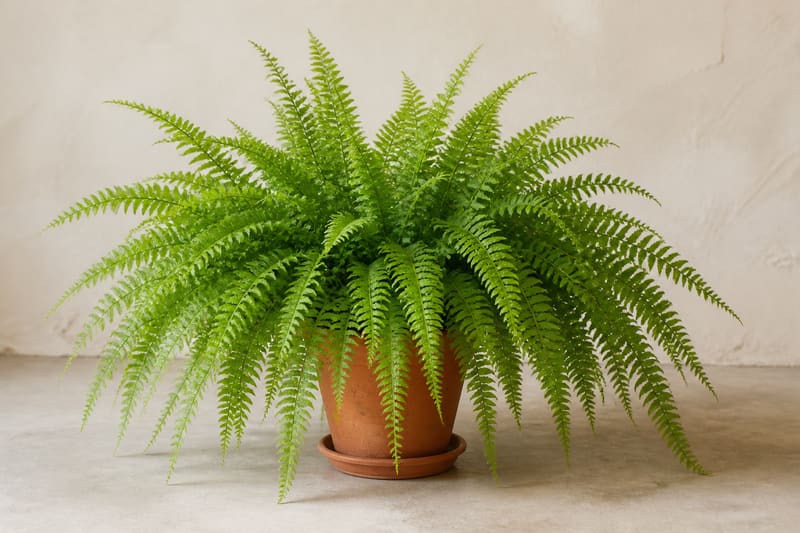
Identify Boston Fern by its fountain of arching pinnate fronds, then coordinate filtered light, even moisture, humidity, drainage, crown care, and seasonal growth.
Light
bright filtered light or partial shade without abrupt harsh sun
Water
keep evenly moist but not saturated, with complete drainage
Soil
moisture-retentive but freely draining peat-free container mix
Temperature
Warm, draft-free
Plant dossier
Plant overview
Boston Fern is the classic arching selection of the accepted species Nephrolepis exaltata. It forms a fountain-shaped crown of long pinnate fronds and is grown indoors for dense, fine-textured evergreen foliage.
Plant identification
Botanical characteristics
- Family
- Polypodiaceae
- Native range
- cultivar of a tropical and subtropical American fern species
- Growth habit
- evergreen stoloniferous fern grown indoors for arching divided fronds
- Care level
- moderate because its fine root mass needs even moisture, humidity, filtered light, and free drainage
- Common names
- Boston Fern, Sword Fern, Bostonfern
- Propagation
- Division, Rooted runners, Spores
- Pet safety
- ASPCA lists Boston Fern as non-toxic to dogs and cats
- Scientific synonyms
- Nephrolepis exaltata, Nephrolepis exaltata cv. Bostoniensis
Look for narrow arching fronds divided into many small pinnae along a central rachis. New fronds emerge coiled from the crown. Mature fertile fronds may carry orderly rows of round sori beneath the pinnae; these are reproductive structures, not automatically pests or disease.
Before you choose
Is this plant a good fit?
A good fit for
- Bright filtered rooms
- Growers who can monitor moisture frequently
- Humid spaces with useful light and airflow
- Pet households seeking an ASPCA-listed non-toxic plant
Think twice if
- Homes that allow baskets to dry completely
- Sealed pots with retained runoff
- Hot vents or freezing windows
- Buyers seeking a drought-tolerant fern
Care foundation
Care summary
Coordinate bright filtered light, even root-zone moisture, free drainage, moderate-to-high humidity, stable warmth, gentle ventilation, restrained feeding, and deliberate crown-safe pruning.
Detailed care
Read the conditions, not a calendar
Light
Bright filtered light or partial shade supports a full sturdy crown. Too little light produces fewer, longer, weak fronds; too much exposure can pale or scorch the canopy. Change exposure gradually.
Watering
The fine root mass should remain evenly moist without standing water. Check more than the surface, water the complete root ball, and empty runoff. Hanging baskets, warmth, and airflow can shorten dry-down; cool low-light periods extend it.
Soil and pot
Use an open moisture-retentive container mix and an unobstructed drainage hole. Keep the crown at its established depth. A decorative outer container must not trap runoff around the root ball.
Temperature and humidity
Stable warmth and moderate-to-high humidity support fine pinnae, but the crown still needs ventilation. Keep the plant away from cold glass, exterior doors, hot vents, and direct humidifier spray.
Getting established
Your first 30 days
- 01
Days 1–3: confirm the cultivar form, photograph the crown, inspect frond undersides, and verify drainage.
- 02
Week 1: learn the moist-to-lighter watering signal without allowing severe drought.
- 03
Week 2: map filtered light, humidity, airflow, and the basket's actual dry-down.
- 04
Weeks 3–4: make one supported adjustment and judge the next green crozier.
Growth and maintenance
Support the way it grows
Growth expectations
- New fronds emerge as coiled croziers from the crown
- Mature fronds arch outward and may carry orderly sori beneath pinnae
- Runners can form new plantlets beyond the main crown
Seasonal changes
- Cool lower-light periods slow water use
- Heated winter air can dry fine pinnae
- Outdoor summer placement requires gradual light acclimation
Common mistakes
- Letting the fine root ball dry completely
- Keeping the pot permanently saturated
- Mistaking sori for pests
- Using misting instead of root watering
Read the plant
Growth signals and practical checks
Healthy growth
- Firm central crown
- Regular green croziers
- Sturdy evenly colored fronds
- Predictable moist but aerated root-zone cycle
Warning signs
- Soft or loose crown in wet mix
- Persistent wetness with failed roots
- Rapidly spreading irregular dark lesions
Common mistakes
- Letting the fine root ball dry completely
- Keeping the pot permanently saturated
- Mistaking sori for pests
- Using misting instead of root watering
Practical notes
- Use the crown and newest croziers as the primary growth record
- Inspect both sides of mature pinnae before diagnosing spots
Safety
Toxicity and safety
ASPCA lists Boston Fern as non-toxic to dogs and cats. Even non-toxic plant material can cause digestive upset if chewed, and pesticide residues create separate risks.
Observation
Problems and observation
Check first
Map whether damage affects an old outer frond, exposed tips, one side of the canopy, the crown, or the full root ball. This spatial pattern separates aging, drought, exposure, pests, and root failure.
Safe next action
Record pot weight, deeper moisture, drain time, crown firmness, crozier count, frond strength, ordered sori, pest evidence, and window direction. Change one condition and use the next complete frond as the response.
04Open a related diagnosis
Frequently asked questions
Are the dark dots under Boston Fern fronds pests?
Regular rows of round dots can be normal sori that produce spores; irregular lesions or movable bodies need separate confirmation.
Is Boston Fern safe for cats and dogs?
ASPCA lists Boston Fern as non-toxic to dogs and cats, although chewing any plant material can still cause digestive upset.
Should Boston Fern soil stay wet?
Keep it evenly moist but aerated, never standing in water or chronically saturated.
Can Boston Fern tolerate a dark room?
It tolerates shade better than many plants, but too little usable light produces fewer, longer, weaker fronds.