
Plant profile
Chlorophytum comosum
Spider Plant
Identify Spider Plant by its arching striped leaves, fleshy roots and plantlet-bearing runners, then use observable light, water and growth signals for care.
Light
bright indirect
Water
allow the mix to dry slightly between thorough waterings
Soil
general-purpose potting mix with reliable drainage
Temperature
Warm, draft-free
Plant dossier
Plant overview
Spider Plant is a clump-forming houseplant with narrow arching leaves and long wiry stems that can carry tiny white flowers and young plantlets. This profile uses Chlorophytum comosum as the canonical entity. Airplane plant, ribbon plant and spider ivy are common-name aliases, not separate species pages.
Its thick fleshy roots store water, but that adaptation does not make a saturated container safe. The useful care model is bright indirect light, a draining root zone, slight drying between thorough waterings and restrained fertilizer during active growth.
Plant identification
Botanical characteristics
- Family
- Asparagaceae
- Native range
- tropical and southern Africa
- Growth habit
- clump-forming evergreen herbaceous perennial
- Care level
- easy
- Common names
- Spider plant, Airplane plant, Ribbon plant, Spider ivy
- Propagation
- Rooted plantlets, Division of established clumps
- Pet safety
- ASPCA lists Spider Plant as non-toxic to cats and dogs
- Scientific synonym
- Anthericum comosum
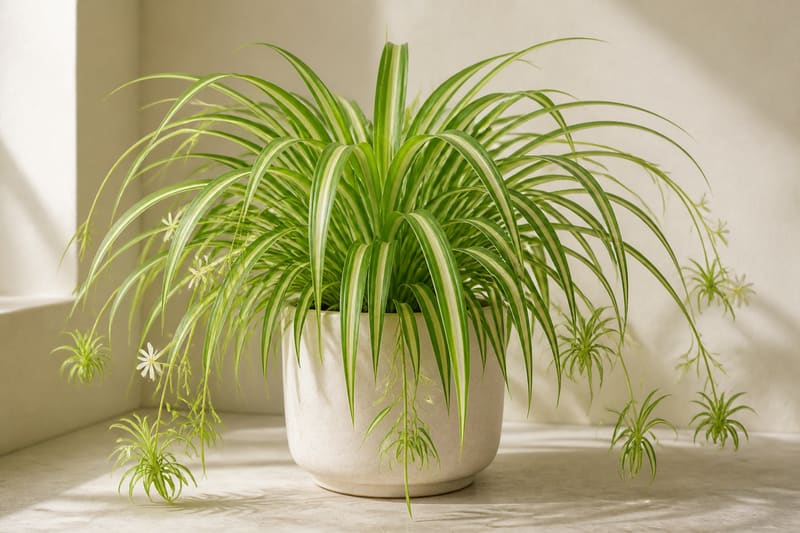
Look for leaves arising as a fountain from a short basal crown. Leaves are linear to lance-shaped and often green with a cream or white longitudinal stripe. Mature plants may send out long slender stems bearing small six-tepaled white flowers followed by miniature rosettes. Those plantlets—not a spider-like leaf shape—explain the common name.
Cultivar matters. ‘Vittatum’ normally has a broad pale center, ‘Variegatum’ has pale margins, ‘Bonnie’ curls, and the species may be all green. Compare several mature leaves and the nursery label before treating stable variegation as chlorosis.
Before you choose
Is this plant a good fit?
A good fit for
- Bright rooms without harsh midday sun
- Hanging baskets or shelves with room for runners
- Growers who want a pet-safe plant listed by ASPCA
Think twice if
- Hot direct-sun windows without screening
- Containers without drainage
- Growers who want a rigid calendar watering schedule
Care foundation
Care summary
Use indirect light, slight drying, complete drainage and conservative feeding. Keep the plant away from frost and hot direct sun, and let observable root-zone and growth signals determine each adjustment.
Detailed care
Read the conditions, not a calendar
Light
Bright indirect light supports compact striped foliage and active plantlet production. Spider Plant tolerates lower light, but tolerance is not maximum performance. Hot direct sun can scorch narrow leaves. Move a plant toward brighter light gradually and judge the new leaves rather than old damage.
Watering
Allow the mix to dry slightly between thorough waterings, then wet the root ball evenly and drain all runoff. Thick roots help the plant tolerate an occasional dry interval, yet continuous saturation can still lead to root rot. Pair leaf posture with pot weight and moisture below the surface.
Soil and pot
Use a general-purpose indoor mix that holds enough moisture to wet evenly while draining freely. Spider Plant often grows well when slightly pot-bound, but roots escaping drainage holes, distorted containers or an increasingly erratic wetting pattern justify repotting. Feed conservatively during active growth; excessive fertilizer can contribute to brown tips and fewer plantlets.
Temperature and humidity
Ordinary warm indoor conditions are suitable when the plant is protected from frost, cold drafts and abrupt heat. Low humidity can contribute to brown tips, but increasing air moisture cannot repair saturated roots, salt accumulation or sun scorch.
Getting established
Your first 30 days
- 01
Days 1–3: verify the label, drainage and a bright indirect-light position.
- 02
Week 1: learn the pot weight after watering and after slight drying.
- 03
Week 2: map existing tip damage and inspect leaf undersides.
- 04
Weeks 3–4: make only one supported change and judge new growth.
Growth and maintenance
Support the way it grows
Growth expectations
- Leaves emerge from a basal rosette
- Long wiry stems can carry small white flowers and plantlets
- Thick fleshy roots may fill a container quickly
Seasonal changes
- Shorter days and cooler rooms can slow water use
- Stronger window sun can scorch leaves after an abrupt move
Common mistakes
- Treating every brown tip as underwatering
- Keeping the pot continuously wet because the plant has fleshy roots
- Feeding heavily to force plantlets
Read the plant
Growth signals and practical checks
Healthy growth
- New leaves keep their cultivar pattern
- The mix moves through a predictable moist-to-slightly-dry cycle
- Runners and plantlets form on a mature actively growing plant
Warning signs
- Soft dark roots with a persistently wet pot
- Rapidly spreading pest damage or webbing
- Crown collapse rather than isolated old-leaf decline
Common mistakes
- Treating every brown tip as underwatering
- Keeping the pot continuously wet because the plant has fleshy roots
- Feeding heavily to force plantlets
Practical notes
- Use the next leaf as the recovery measure because brown or yellow tissue will not turn green
- Distinguish natural cultivar variegation from new paling by comparing several leaves and the plant label
Safety
Toxicity and safety
ASPCA classifies Spider Plant as non-toxic to cats and dogs. This is a pet-toxicity classification, not a promise that chewing causes no digestive upset. Laboratory air-pollutant research should not be converted into a claim that one potted plant purifies an ordinary room; ventilation and source control remain separate concerns.
Observation
Problems and observation
Check first
Brown tips, yellowing, curling and drooping are observations rather than diagnoses. Map leaf age and damage location, compare pot weight with moisture below the surface, and inspect roots or pests only when the evidence supports that disturbance.
Safe next action
Record the whole rosette, the newest leaf, the root-zone condition and recent changes together. Test one correction, then compare the next leaf or runner. A stable new growth cycle is stronger evidence than the appearance of an old damaged tip.
04Open a related diagnosis
Frequently asked questions
Is Spider Plant safe for cats and dogs?
ASPCA lists Chlorophytum comosum as non-toxic to cats and dogs, although chewing any plant material can still cause an individual animal gastrointestinal upset.
Why does a Spider Plant make babies?
Small plantlets form on long flowering stems of a mature plant; light cycle, cultivar, maturity and restrained feeding all influence production.
Is an Airplane Plant the same as a Spider Plant?
Airplane plant is a common-name alias for Chlorophytum comosum, the entity covered by this profile.
Are all Spider Plants striped?
No. The species can be green, while cultivars such as Vittatum and Variegatum carry different white stripe patterns and Bonnie has curled foliage.