
Plant profile
Dracaena sanderiana
Lucky Bamboo
Identify Lucky Bamboo as Dracaena sanderiana, then coordinate water or soil culture, filtered light, roots, cane health, feeding, propagation, pests, and pet safety.
Light
Bright indirect or filtered
Water
Let upper mix dry
Soil
Well-drained indoor potting mix in a proportional pot when grown in soil
Temperature
Warm, draft-free
Plant dossier
Plant overview
Lucky Bamboo is Dracaena sanderiana, an evergreen tropical subshrub in the Asparagaceae family. Kew accepts the species and records its native range from West-Central Tropical Africa to northeastern Angola. The familiar display uses cane cuttings that root in water or soil and produce leafy shoots.
Plant identification
Botanical characteristics
- Family
- Asparagaceae
- Native range
- West-Central Tropical Africa to northeastern Angola
- Growth habit
- evergreen tropical subshrub with upright cane-like stems and leafy shoots
- Care level
- Beginner to intermediate
- Common names
- Lucky Bamboo, Friendship Bamboo, Ribbon Plant, Water Bamboo
- Propagation
- healthy shoot cuttings with viable nodes
- Pet safety
- Toxic to dogs and cats; Dracaena species contain saponins and ingestion can cause vomiting, depression, loss of appetite, hypersalivation, and dilated pupils in cats
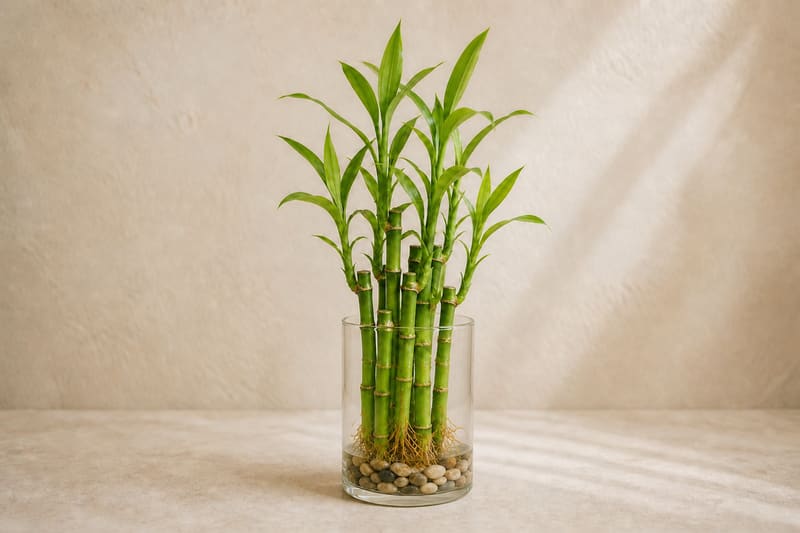
Look for upright fleshy green cane-like stems with clear nodes and simple narrow lance-shaped leaves on side or upper shoots. Commercial canes may be straight, bent, braided, or trained, but the plant is a Dracaena rather than a grass-family bamboo.
Care foundation
Care summary
Coordinate bright filtered light, clean root conditions, appropriate water or soil culture, conservative feeding, stable warmth, node-aware propagation, and prompt isolation of soft cane tissue.
Detailed care
Read the conditions, not a calendar
Light
Use bright indirect or filtered light and protect shade-adapted leaves from hot direct sun. Lower light may maintain the plant but usually slows leafy shoot growth.
Watering
For water culture, replace the reservoir with clean low-mineral water and keep roots—not long sections of cane—submerged. For soil culture, water when the upper inch begins to dry, then drain completely.
Soil and pot
Use a structured indoor potting mix and a modest draining pot. Keep the cane at its established depth and never treat an undrained soil container like a water-culture glass.
Temperature and humidity
Maintain stable indoor warmth away from cold drafts, radiators, and hot glass. Ordinary-to-moderate humidity is suitable when root water is correct; inspect for mites rather than misting automatically.
Getting established
Your first 30 days
- 01
Days 1–3: confirm Dracaena sanderiana, photograph leaves, shoots, nodes, roots, and growing medium, and inspect cane firmness.
- 02
Week 1: map filtered light, direct sun, heat, pet access, water quality, reservoir depth or soil moisture, and visible pests.
- 03
Week 2: clean the vessel or verify soil drainage, then observe roots and the newest leaf without feeding automatically.
- 04
Weeks 3–4: make one supported adjustment and judge new roots, firm green cane, and clean new leaves rather than old damage.
Growth and maintenance
Support the way it grows
Common mistakes
- Treating Lucky Bamboo as true bamboo
- Submerging too much cane
- Topping up mineralized water indefinitely
- Using direct hot sun
- Feeding stressed roots
- Assuming every brown root is rotten
Read the plant
Growth signals and practical checks
Common mistakes
- Treating Lucky Bamboo as true bamboo
- Submerging too much cane
- Topping up mineralized water indefinitely
- Using direct hot sun
- Feeding stressed roots
- Assuming every brown root is rotten
Practical notes
- Separate root color from root firmness
- Keep water-grown and soil-grown care records distinct
- Mark the water line and newest leaf for comparison
Safety
Toxicity and safety
ASPCA lists Dracaena as toxic to dogs and cats and identifies saponins. Prevent access and contact a veterinarian or poison-control professional after suspected ingestion.
Observation
Problems and observation
Check first
Separate leaf tips, whole leaves, shoots, cane segments, and roots. Add water source, reservoir depth, water clarity, soil moisture, tissue firmness, light, heat, and visible pests before acting.
Safe next action
Photograph every cane base, the water line or soil surface, roots, newest leaves, and any damage boundary. Record water source, cleaning interval, fertilizer, evaporation, direct-ray limits, and root firmness so future change has a real baseline.
04Open a related diagnosis
Frequently asked questions
Is Lucky Bamboo a true bamboo?
No. It is Dracaena sanderiana, an Asparagaceae subshrub native to tropical Africa.
Can Lucky Bamboo grow in water permanently?
It can remain in clean water when roots are covered, the cane is not deeply submerged, the vessel is cleaned, and nutrition is supplied very conservatively.
Is Lucky Bamboo safe for cats and dogs?
No. ASPCA lists Dracaena as toxic to dogs and cats.