
Plant profile
Pachira aquatica
Money Tree
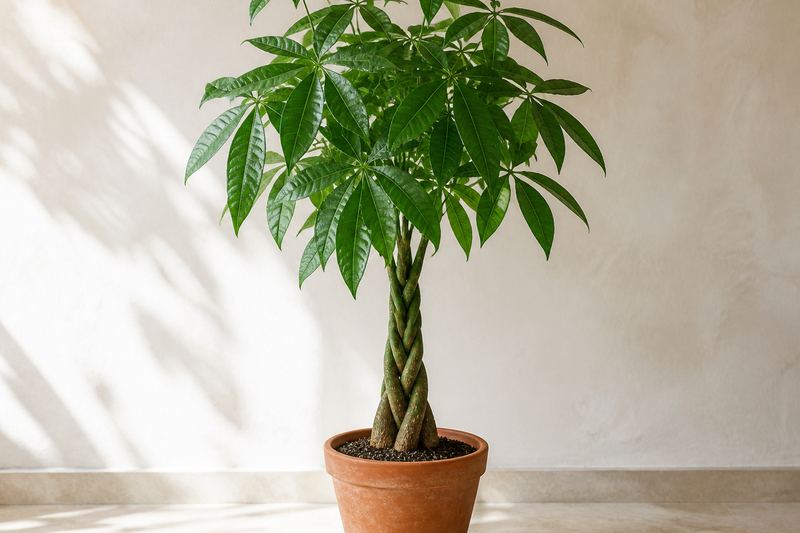
Identify Money Tree by its woody or braided trunks and palmately compound leaves, then coordinate filtered light, even drainage, watering, and trunk-by-trunk observation.
Light
bright filtered or indirect light with gradual exposure changes
Water
water evenly after the upper root zone dries, then remove all runoff
Soil
open moisture-retentive but freely draining container mix
Temperature
Warm, draft-free
Plant dossier
Plant overview
Pachira aquatica is an accepted tropical evergreen tree in Malvaceae, native from Mexico through tropical Central and South America. Indoors it is commonly sold as a compact foliage plant with several flexible young trunks braided together.
Plant identification
Botanical characteristics
- Family
- Malvaceae
- Native range
- Mexico through tropical Central and South America
- Growth habit
- tropical evergreen tree commonly grown as a compact foliage houseplant
- Care level
- manageable with bright filtered light, free drainage, stable warmth, and trunk-by-trunk inspection
- Common names
- Money Tree, Money Plant, Guiana Chestnut, Malabar Chestnut, French Peanut
- Propagation
- Stem cuttings, Semi-ripe cuttings, Air layering, Seed
- Pet safety
- ASPCA lists Pachira aquatica as non-toxic to dogs, cats, and horses, while noting plant ingestion may still cause gastrointestinal upset
- Scientific synonyms
- Bombax aquaticum, Bombax macrocarpum, Carolinea princeps
Look for glossy palmately compound leaves: usually five or more narrow leaflets radiate from one point at the end of a long petiole. Trunks are green when young and become grey-brown. A commercial braid contains multiple stems and may represent several individual plants.
Before you choose
Is this plant a good fit?
A good fit for
- Bright filtered rooms
- Growers who inspect soil before watering
- Indoor tree form without a large footprint
Think twice if
- Sealed cachepots with retained runoff
- Cold entryways
- Buyers expecting guaranteed luck or indoor flowers
Care foundation
Care summary
Coordinate bright filtered light, evenly distributed watering with complete drainage, an open root zone, stable warmth, restrained feeding during active growth, and deliberate pruning.
Detailed care
Read the conditions, not a calendar
Light
Bright filtered or indirect light supports a balanced canopy. Weak light produces sparse one-sided extension; abrupt direct sun can scorch exposed leaflets. Increase light in stages and rotate only after the plant has adapted.
Watering
Check more than the surface. Water when the upper zone is dry and the pot has lightened without allowing chronic collapse, then wet the root ball evenly and empty all runoff. Lower light and temperature extend the interval.
Soil and pot
Use an open container mix that retains some moisture but returns air after watering. Keep all trunk bases at their established depth and use an unobstructed drainage hole. Native wetland habitat does not make standing water safe in an indoor pot.
Temperature and humidity
Stable warm conditions and moderate indoor humidity support new leaves. Protect the canopy from cold doors, cold glass, and hot vents. Humidity does not replace root watering, and wet foliage can complicate leaf-spot monitoring.
Getting established
Your first 30 days
- 01
Days 1–3: confirm Pachira aquatica from compound leaves, inspect every trunk, remove retained runoff, and map window light.
- 02
Week 1: wait for a verified watering signal instead of following the seller's schedule.
- 03
Week 2: check hidden ties, soil depth around trunk bases, and drainage without dismantling a healthy braid.
- 04
Weeks 3–4: make one supported adjustment and judge the next compound leaf.
Growth and maintenance
Support the way it grows
Growth expectations
- New compound leaves open folded before flattening
- Braided pots can contain several separate young plants
- Indoor plants remain much smaller and rarely flower
Seasonal changes
- Cooler lower-light periods slow water use
- Summer placement changes need gradual acclimation
- Indoor heating can dry leaflet margins
Common mistakes
- Treating every plant in a braid as one trunk
- Leaving runoff in a decorative sleeve
- Putting the canopy in harsh direct sun
- Feeding to correct low light
Read the plant
Growth signals and practical checks
Healthy growth
- Firm anchored trunks
- Balanced full-size compound leaves
- Predictable moist-to-lightly-dry root-zone cycle
Warning signs
- One soft dark trunk base
- Persistent wetness with loose roots
- Rapidly spreading leaf lesions
Common mistakes
- Treating every plant in a braid as one trunk
- Leaving runoff in a decorative sleeve
- Putting the canopy in harsh direct sun
- Feeding to correct low light
Practical notes
- Inspect every trunk and branch as a separate evidence path
- Use complete compound leaves rather than single leaflets to map canopy patterns
Safety
Toxicity and safety
ASPCA lists Money Tree as non-toxic to dogs and cats, but any chewed plant material can cause stomach upset. The common name is shared with toxic Jade Plant, so retain the scientific identity when discussing safety.
Observation
Problems and observation
Check first
Map whether one leaflet, one compound leaf, one branch, one trunk, or the full braid is affected. That spatial pattern often separates isolated injury from a whole-root-zone problem.
Safe next action
Record pot weight, deeper moisture, drain time, root anchorage, trunk firmness, leaf direction, and window exposure. Change one condition and use the next opened compound leaf as the response.
04Open a related diagnosis
Frequently asked questions
Is every plant called Money Plant Pachira aquatica?
No. Money plant is an ambiguous common name also used for unrelated plants such as Jade Plant and Chinese Money Plant; confirm the scientific identity and compound leaves.
Is Money Tree safe for cats and dogs?
ASPCA lists Pachira aquatica as non-toxic to dogs and cats, though chewing plant material can still cause stomach upset.
Does braiding happen naturally?
No. Commercial growers braid several flexible young trunks; inspect each trunk separately as the plants mature.
Will a Money Tree flower indoors?
Indoor container plants rarely flower, so healthy foliage and trunk growth are more useful expectations.