
Plant profile
Heptapleurum arboricola
Dwarf Umbrella Tree
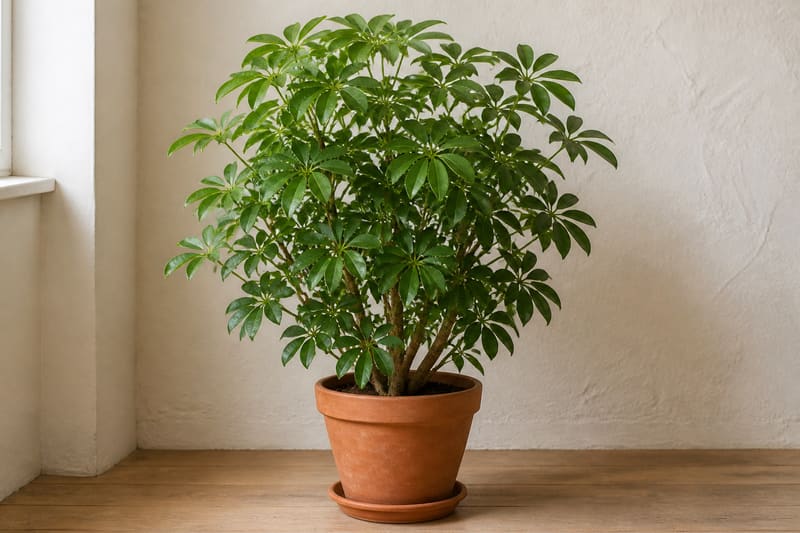
Identify Dwarf Umbrella Tree by its glossy palmate leaf fans and branching woody stems, then coordinate filtered light, measured dry-down, pruning, and pest inspection.
Light
bright filtered or indirect light with gradual acclimation to stronger exposure
Water
water thoroughly after substantial occupied-root-zone dry-down, then drain completely
Soil
structurally stable well-drained houseplant mix in a proportionate draining pot
Temperature
Warm, draft-free
Plant dossier
Plant overview
Dwarf Umbrella Tree is the familiar houseplant long sold as Schefflera arboricola. Kew accepts Heptapleurum arboricola, an Araliaceae scrambling shrub native to Hainan and Taiwan, and records Schefflera arboricola as its synonym. Indoors it is trained into a compact branching shrub or small tree.
Plant identification
Botanical characteristics
- Family
- Araliaceae
- Native range
- Hainan and Taiwan
- Growth habit
- evergreen wet-tropical scrambling shrub commonly trained as a compact branching indoor shrub or small tree
- Care level
- straightforward when filtered light, measured dry-down, warm stability, and pest inspection are maintained
- Common names
- Dwarf Umbrella Tree, Dwarf Schefflera, Hawaiian Umbrella Tree, Umbrella Plant, Parasol Plant
- Propagation
- Stem cuttings, Air layering
- Pet safety
- ASPCA lists Schefflera as toxic to dogs and cats
- Scientific synonym
- Schefflera arboricola
Look for woody branching stems carrying long petioles that end in palmate compound leaves. Each glossy leaf fan commonly radiates seven to nine obovate or elliptic leaflets from one point. Do not merge it with the much larger Australian Umbrella Tree, Heptapleurum actinophyllum, or with unrelated plants that share “umbrella plant” as a common name. Variegated cultivars need their stable cream or yellow pattern identified before chlorosis is diagnosed.
Before you choose
Is this plant a good fit?
A good fit for
- Bright rooms needing a branching foliage shrub
- Growers willing to observe branch and root evidence
- Spaces with stable warmth
Think twice if
- Homes where pets can chew reachable foliage
- Sealed decorative pots
- Cold drafts or harsh unacclimated sun
Care foundation
Care summary
Coordinate bright filtered light, gradual acclimation, a loose draining mix, evidence-based watering, conservative feeding during active growth, moderate humidity with airflow, and clean node-aware pruning. The plant tolerates some variation, but survival in a dim corner is not the same as compact active growth.
Detailed care
Read the conditions, not a calendar
Light
Useful filtered light keeps internodes compact and leaf fans full. Deep shade can produce sparse directional growth, while abrupt hot direct sun can scorch exposed leaflet surfaces. Increase exposure in stages and judge the next two nodes rather than old stretched stems.
Watering
Allow the occupied root zone to dry substantially before watering completely and removing runoff. Combine pot weight, deeper moisture, root volume, light, and temperature; the same container dries more slowly after winter light declines or after heavy pruning.
Soil and pot
Use a loose, organic, well-drained houseplant mix in a container with an open drainage hole. Keep pot volume proportional to the roots and preserve the original stem-base depth. A physically top-heavy canopy needs a stable pot, not buried stems or a large reservoir of unused wet mix.
Temperature and humidity
Maintain warm stable conditions, moderate humidity, and airflow without cold drafts, direct radiator heat, or persistent wet foliage. Map the actual boundary at canopy height because separate branches may experience different heat, glass, and air movement.
Getting established
Your first 30 days
- 01
Days 1–3: confirm palmate compound leaves, branch map, drainage, deeper moisture, and pet placement.
- 02
Week 1: photograph existing marks and avoid watering until substantial dry-down is verified.
- 03
Week 2: stabilize filtered light away from drafts and hot glass.
- 04
Weeks 3–4: make one evidence-led correction and judge the next leaf fan.
Growth and maintenance
Support the way it grows
Growth expectations
- New palmate leaves unfold at branch tips
- Pruning healthy stems can activate lateral shoots below a node
- Indoor flowering is uncommon
Seasonal changes
- Lower winter light slows dry-down
- Direct summer exposure requires acclimation
- Heating and cold glass create localized branch stress
Common mistakes
- Fixed weekly watering
- Confusing Dwarf Umbrella Tree with the larger Australian Umbrella Tree
- Pruning before correcting weak light
- Ignoring scale or mite evidence inside dense foliage
Read the plant
Growth signals and practical checks
Healthy growth
- Firm branching stems
- Compact internodes with symmetrical glossy leaf fans
- Predictable moist-to-substantially-dry root-zone cycle
Warning signs
- Loose or soft stem base
- Rapid green leaf drop after chilling
- Recurring sticky honeydew or fine webbing
Common mistakes
- Fixed weekly watering
- Confusing Dwarf Umbrella Tree with the larger Australian Umbrella Tree
- Pruning before correcting weak light
- Ignoring scale or mite evidence inside dense foliage
Practical notes
- Map each symptom to one leaf fan and supporting branch
- Compare new internodes rather than expecting old stretched growth to shorten
Safety
Toxicity and safety
ASPCA lists Schefflera as toxic to dogs and cats and describes oral irritation and related signs. Keep the plant inaccessible. After suspected ingestion or symptoms, contact a veterinarian or animal poison-control service rather than using a home remedy.
Observation
Problems and observation
Check first
Yellowing, leaf drop, drooping, spots, curling, sticky residue, stippling, and long internodes are observations rather than diagnoses. Map leaf age, leaflet surface, petiole, branch, root-zone moisture, spread, residue, and recent change before selecting a response.
Safe next action
Photograph the complete leaf fan and its supporting branch. Record pot weight, deeper moisture, new internode length, leaf-fan symmetry, exact window direction, sticky residue, scale covers, and mite webbing. Change one variable and use the next terminal leaf as the response record.
04Open a related diagnosis
Frequently asked questions
Is Schefflera arboricola still the accepted botanical name?
Kew accepts Heptapleurum arboricola and lists Schefflera arboricola as a synonym; Schefflera remains the familiar horticultural search name.
Is Dwarf Umbrella Tree the same as Australian Umbrella Tree?
No. Heptapleurum actinophyllum is a different, much larger species; this profile covers Heptapleurum arboricola.
Is Schefflera safe for cats and dogs?
No. ASPCA lists Schefflera as toxic to dogs and cats. Keep it inaccessible and contact a veterinarian after suspected ingestion or symptoms.
Will a leggy branch become compact again?
Existing internodes will not shorten. Improve light and evaluate new growth before deliberate pruning.