
Plant profile
Anthurium andraeanum
Anthurium
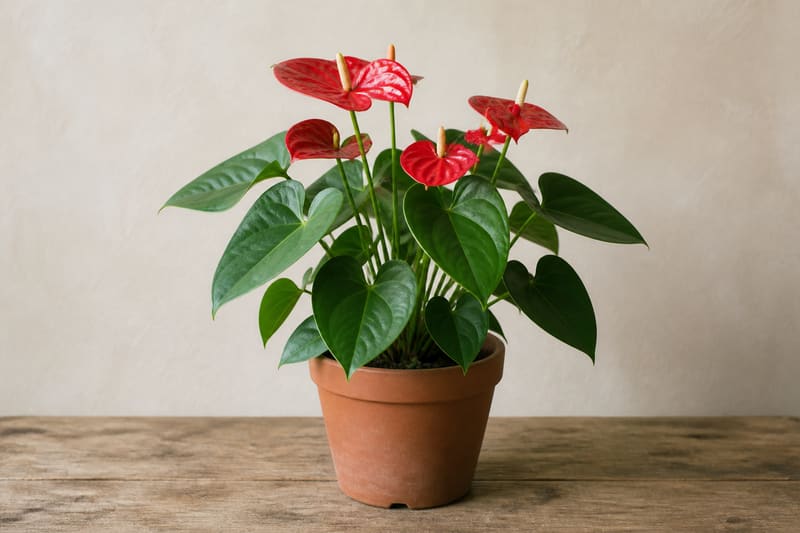
Identify Anthurium andraeanum by glossy heart-shaped leaves, colorful spathes, a straight spadix, epiphytic roots, and its warm bright-indirect indoor needs.
Light
Bright indirect or filtered
Water
Let upper mix dry
Soil
Airy acidic potting mix with structural particles
Temperature
Warm, draft-free
Plant dossier
Plant overview
Anthurium andraeanum is the classic flowering Anthurium sold as Flamingo Flower, Flamingo Lily, Laceleaf, Painter's Palette, or Tailflower. Kew treats the species as accepted and native from Colombia to Ecuador. It belongs to Araceae and grows naturally as an epiphytic subshrub in wet tropical habitat.
Plant identification
Botanical characteristics
- Family
- Araceae
- Native range
- Colombia to Ecuador
- Growth habit
- evergreen epiphytic or terrestrial clump-forming tropical perennial with glossy cordate leaves and upright spathes
- Care level
- moderate because flowering and leaf quality depend on bright filtered light, stable warmth, an airy acidic root zone, measured moisture, and humidity with airflow
- Common names
- Anthurium, Flamingo Flower, Flamingo Lily, Laceleaf, Painter's Palette, Tailflower
- Propagation
- Rooted division, Offsets, Stem or rhizome cuttings with viable nodes
- Pet safety
- Not pet-safe; ingestion can cause oral irritation, drooling, vomiting, and difficulty swallowing. Contact a veterinarian after suspected exposure.
Look for glossy dark-green heart-shaped leaves, a compact clump, fleshy roots, and upright flower stalks. The showy red, pink, orange, white, or green structure is a spathe, not a petal. Its straight cream or yellow spadix carries the small true flowers. A corkscrew-like spadix points instead toward Anthurium scherzerianum or a related hybrid.
Before you choose
Is this plant a good fit?
A good fit for
- Warm rooms with bright filtered light
- Growers who inspect moisture below the surface
- Flowering displays beyond pet and child reach
- Airy pots with reliable drainage
Think twice if
- Cold drafty windows
- Homes where pets can chew leaves
- Dense soil or sealed containers
- Fixed watering routines
Care foundation
Care summary
Coordinate bright filtered light, warm conditions, moderate-to-high humidity with airflow, an open acidic mix, complete watering followed by drainage, and measured feeding only during active healthy growth.
Detailed care
Read the conditions, not a calendar
Light
Use abundant indirect light at leaf level. Too little usable light can reduce flowering and slow growth; abrupt hot direct sun can bleach or scorch exposed leaves. Move the plant gradually and evaluate the next leaf or spathe.
Watering
Check below the surface and compare pot weight. Water the root zone thoroughly as the upper mix approaches dry, then drain it completely. Never leave the nursery pot submerged inside a cachepot. Lower seasonal light normally lengthens the dry-down.
Soil and pot
Use an open acidic mix that combines moisture distribution with large air spaces. A modest draining pot is safer than a much larger container. Dense garden soil and collapsed fine mix hold too much water around fleshy roots.
Temperature and humidity
Maintain stable room warmth away from cold glass, drafts, and heater outlets. Moderate-to-high humidity supports broad leaves, but misting is not a substitute for root watering and wet stagnant foliage can support disease.
Getting established
Your first 30 days
- 01
Keep nursery conditions stable while recording light and pot dry-down
- 02
Inspect drains and empty the cachepot after watering
- 03
Keep away from cold glass children and pets
- 04
Delay repotting and feeding unless direct evidence justifies them
Growth and maintenance
Support the way it grows
Growth expectations
- New leaves emerge folded and expand glossy
- Spathes can remain attractive for several weeks and may green with age
- Basal shoots or additional stems can create a fuller clump
Seasonal changes
- Lower winter light slows growth and dry-down
- Warm brighter periods increase demand and scorch risk
Common mistakes
- Treating the red spathe as a flower petal
- Watering on a fixed weekday
- Using dense garden soil
- Placing leaves against cold glass
- Feeding a plant with failed roots
Read the plant
Growth signals and practical checks
Healthy growth
- Firm glossy new leaves
- Firm roots in an airy progressively drying mix
- Upright spathes without wet lesions
- Predictable recovery after watering
Warning signs
- Soft brown roots in sour wet mix
- Rapidly expanding water-soaked leaf lesions
- Collapsing petiole bases or persistent whole-plant droop
Common mistakes
- Treating the red spathe as a flower petal
- Watering on a fixed weekday
- Using dense garden soil
- Placing leaves against cold glass
- Feeding a plant with failed roots
Practical notes
- Track each spathe by age before diagnosing green color
- Read moisture below the surface because an airy top can hide a wet center
Safety
Toxicity and safety
Anthurium contains insoluble calcium oxalate crystals. Chewing can cause oral pain, drooling, swelling, vomiting, and difficulty swallowing; sap may irritate skin or eyes. Keep it away from children and pets, wear gloves for pruning, and contact an appropriate medical or veterinary professional after exposure.
Observation
Problems and observation
Check first
Yellowing, browning, drooping, curling, spots, and missing flowers are observations, not final diagnoses. Map leaf age, tissue texture, root condition, deep moisture, spathe stage, and recent change before selecting one correction.
Safe next action
Photograph the full plant from above and the side. Record the newest leaf, oldest leaf, each spathe's age, pot weight, moisture depth, drain time, light direction, and temperature exposure. Use one new leaf, root tip, or spathe as the response signal.
04Open a related diagnosis
Frequently asked questions
Is the red part of an Anthurium the flower?
The colorful heart-shaped part is a spathe. The many small true flowers are carried on the central spadix.
Is Anthurium safe for cats and dogs?
No. Anthurium contains calcium oxalate crystals and can cause painful oral irritation if chewed; keep it inaccessible and contact a veterinarian after suspected exposure.
Why does an Anthurium spathe turn green?
An older spathe may green naturally as it ages. Consistently small green new spathes can also accompany insufficient usable light.
Can one Anthurium leaf grow a new plant?
A detached leaf blade alone is not a reliable propagation unit. Use a rooted division, offset, or stem section with a viable node.