
Plant profile
Chrysalidocarpus lutescens
Areca Palm
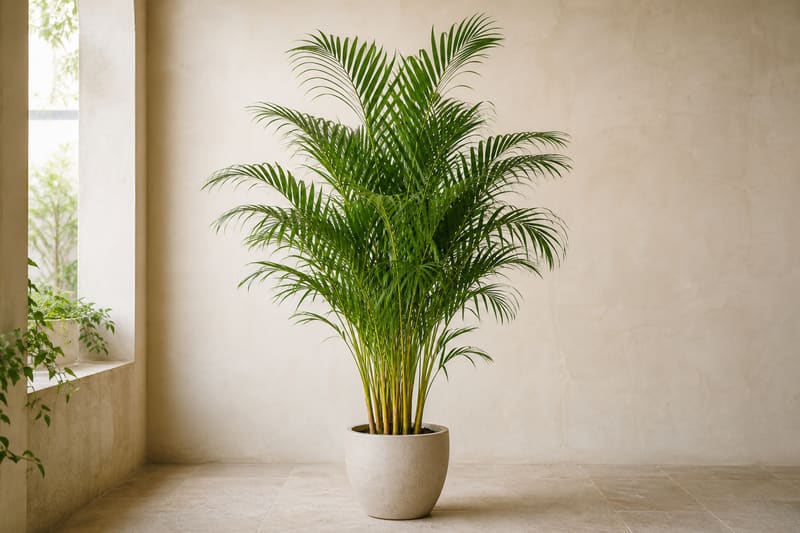
Identify Areca Palm by its clustered yellow-green canes and arching pinnate fronds, then coordinate bright indirect light, measured moisture, clean pruning, and pest inspection.
Light
bright indirect or filtered light with gradual acclimation to stronger exposure
Water
water thoroughly after much of the occupied root zone has dried, then drain completely
Soil
fertile structurally stable well-drained container mix in a proportionate draining pot
Temperature
Warm, draft-free
Plant dossier
Plant overview
Areca Palm is the familiar indoor name for Chrysalidocarpus lutescens, a clumping palm native to eastern Madagascar. Kew accepts that name and lists the widely used Dypsis lutescens as a synonym. Retail pots may contain a dense group of canes, but the plant remains structurally different from a branching shrub.
Plant identification
Botanical characteristics
- Family
- Arecaceae
- Native range
- eastern Madagascar
- Growth habit
- evergreen clumping tropical palm with multiple yellow-green canes and arching pinnate fronds
- Care level
- moderate because moisture, bright indirect light, mineral stress, and mites must be balanced
- Common names
- Areca Palm, Butterfly Palm, Golden Cane Palm, Golden Butterfly Palm, Yellow Palm
- Propagation
- Seed, Division of a confirmed rooted clump
- Pet safety
- ASPCA lists Areca Palm as non-toxic to dogs and cats
- Scientific synonym
- Dypsis lutescens
Look for multiple smooth yellow-green canes rising from the base and arching pinnate fronds with many narrow leaflets arranged along a central rachis. Do not merge it with Betel Nut Palm, Areca catechu, merely because both use “areca” in common or botanical names. Separate naturally yellowish canes from new leaflet chlorosis.
Before you choose
Is this plant a good fit?
A good fit for
- Bright rooms with space for arching fronds
- Growers willing to monitor root-zone moisture and mineral residue
- Pet households seeking an ASPCA-listed non-toxic palm
Think twice if
- Dark corners
- Sealed decorative pots
- Cold drafts or direct heating airflow
Care foundation
Care summary
Provide bright indirect light, a fertile aerated mix, complete drainage, warm stability, moderate humidity with airflow, conservative feeding during active growth, and regular inspection for mites and scale. Make one interpretable correction at a time.
Detailed care
Read the conditions, not a calendar
Light
Bright indirect or filtered light supports active spear opening and balanced color. Deep shade slows growth and encourages a one-sided canopy; abrupt hot direct exposure can bleach and scorch leaflets. Increase exposure gradually and judge the next emerging frond.
Watering
Water the complete root ball after much of the occupied root zone has dried, then remove all runoff. Avoid both prolonged saturation and repeated severe drought. Pot weight, deeper moisture, root volume, light, and temperature are more reliable than a fixed weekday.
Soil and pot
Use a fertile, structurally stable, well-drained container mix in a pot with an open drainage hole. Keep the root volume proportional to the container and preserve the established cane-base depth. A stable outer pot may support the canopy but must not trap runoff.
Temperature and humidity
Maintain warm, draft-free conditions with moderate humidity and gentle airflow. Keep fronds away from direct radiator or air-conditioner streams. Humidity support cannot compensate for wet roots or remove an established mite colony.
Getting established
Your first 30 days
- 01
Days 1–3: confirm the accepted entity, pinnate fronds, clumping cane habit, drainage, and existing damage.
- 02
Week 1: map light, airflow, root-zone moisture, and mineral residue.
- 03
Week 2: stabilize bright indirect light and complete one evidence-based dry-down.
- 04
Weeks 3–4: inspect mites and judge adjustment from the next firm central spear.
Growth and maintenance
Support the way it grows
Growth expectations
- New pinnate fronds emerge as upright central spears
- Individual canes do not branch after topping
- A healthy clump can produce additional rooted shoots from its base
Seasonal changes
- Lower winter light slows water use
- Hot window exposure can increase scorch and dry-air stress
- Heated indoor air can increase mite pressure
Common mistakes
- Fixed weekly watering
- Treating brown tips as proof of low humidity
- Topping canes to control height
- Missing mites inside dense fronds
Read the plant
Growth signals and practical checks
Healthy growth
- Firm yellow-green canes
- Central spears that open into evenly colored arching fronds
- Predictable moist-to-partly-dry root-zone cycle without retained runoff
Warning signs
- Loose or soft cane base
- Persistent wetness with widespread yellowing
- Recurring honeydew, stippling, or fine webbing
Common mistakes
- Fixed weekly watering
- Treating brown tips as proof of low humidity
- Topping canes to control height
- Missing mites inside dense fronds
Practical notes
- Map every symptom to a specific frond and cane
- Use the next central spear rather than old damaged tissue to judge recovery
Safety
Toxicity and safety
ASPCA lists Areca Palm as non-toxic to dogs and cats. That classification does not make chewing desirable; keep normal household supervision and contact a veterinarian if an animal develops symptoms after ingesting plant material.
Observation
Problems and observation
Check first
Yellowing, leaflet drop, drooping, brown spots, curling, brown tips, root decline, sticky residue, and stippling are observations rather than diagnoses. Map frond age, canopy location, cane firmness, root-zone moisture, spread, residue, water history, and living pests.
Safe next action
Photograph the complete frond and its cane. Record pot weight, deeper moisture, central-spear firmness, light direction, salt crust, sticky residue, scale covers, and mite webbing. Preserve one unaffected frond as a comparison while testing a single correction.
04Open a related diagnosis
Frequently asked questions
Is Dypsis lutescens still the accepted botanical name?
Kew accepts Chrysalidocarpus lutescens and lists Dypsis lutescens as a synonym; both names remain important for identification and search.
Is Areca Palm the same as Betel Nut Palm?
No. Areca catechu is a different palm; this profile covers Chrysalidocarpus lutescens.
Is Areca Palm safe for cats and dogs?
ASPCA lists Areca Palm as non-toxic to dogs and cats, but chewing plant material can still cause nonspecific digestive upset.
Can I shorten an Areca Palm by topping a cane?
No. Remove only justified fronds; cutting the growing point does not create a shorter branching palm.