
Plant profile
Aspidistra elatior
Cast Iron Plant
Identify Cast Iron Plant by its rhizome-borne leathery leaves, then coordinate shade, measured watering, drainage, restrained feeding, and slow growth.
Light
low to moderate filtered light or shade, protected from direct sun
Water
Let upper mix dry
Soil
rich but freely draining peat-free container mix around firm rhizomes
Temperature
moderate indoor conditions protected from freezing exposure and hot vents
Plant dossier
Plant overview
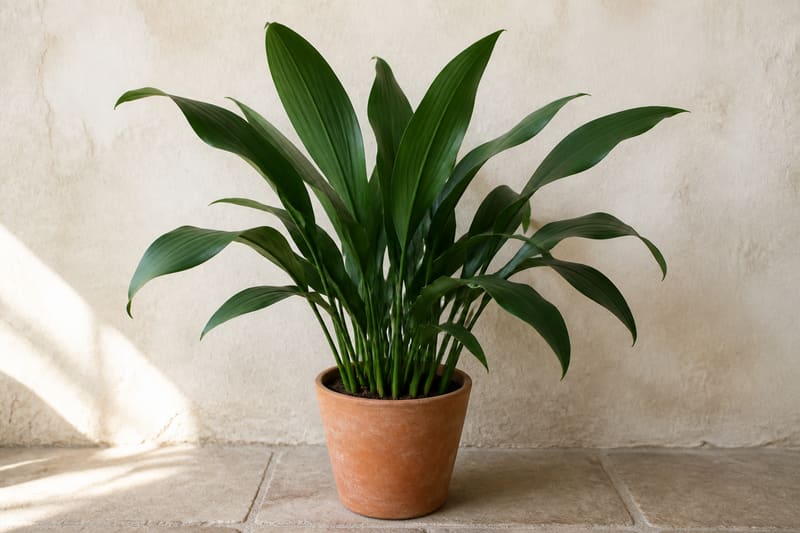
Cast Iron Plant is the accepted species Aspidistra elatior, a slow evergreen rhizomatous perennial native to southern Japan. Its long, dark green, leathery leaves rise individually from the soil and form a durable upright clump.
Plant identification
Botanical characteristics
- Family
- Asparagaceae
- Native range
- southern Japan
- Growth habit
- slow-growing evergreen rhizomatous perennial with upright leathery leaves
- Care level
- easy because it tolerates shade and occasional dryness, but it still requires drainage and usable light
- Common names
- Cast Iron Plant, Bar Room Plant, Barroom Plant, Common Aspidistra
- Propagation
- Rhizome division
- Pet safety
- ASPCA lists Aspidistra elatior as non-toxic to dogs, cats, and horses
- Scientific synonym
- Aspidistra insularis
Look for broad lance-shaped leaves with entire margins and parallel veins, each carried on a long petiole emerging directly from the rhizome. There is no visible woody trunk. Small flowers, when produced, sit close to soil level and are easily missed.
Before you choose
Is this plant a good fit?
A good fit for
- Low to moderate filtered-light rooms
- Growers seeking a slow durable foliage plant
- Homes with ordinary humidity
- Pet households seeking an ASPCA-listed non-toxic plant
Think twice if
- Strong direct-sun windows
- Sealed pots with retained runoff
- Buyers expecting rapid growth
- Windowless rooms without suitable artificial light
Care foundation
Care summary
Coordinate shade or filtered light, upper-compost dry-down, complete watering with drainage, moderate temperatures, ordinary humidity, light feeding, and careful rhizome-level pruning.
Detailed care
Read the conditions, not a calendar
Light
Low to moderate filtered light or shade suits the species. Direct sun can bleach or scorch leaves. Shade tolerance does not mean it can grow without usable natural or artificial light.
Watering
Let the upper compost become dry to the touch, verify deeper moisture and pot weight, then water the full root ball and discard runoff. Reduce frequency as winter growth and evaporation slow.
Soil and pot
Use rich but freely draining peat-free mix in a container with an open drain. Keep rhizomes at their established depth and avoid a much larger pot that holds excess wet mix.
Temperature and humidity
Moderate indoor temperatures and ordinary humidity are usually adequate. Avoid freezing exposure, hot vents, direct humidifier spray, and large abrupt changes.
Getting established
Your first 30 days
- 01
Days 1–3: confirm the plain-green species form, inspect petiole bases and both leaf surfaces, and verify drainage.
- 02
Week 1: map filtered usable light and learn the upper-compost dry signal.
- 03
Week 2: record pot weight, drain time, rhizome firmness, and new shoots.
- 04
Weeks 3–4: make one supported adjustment and judge the next firm shoot.
Growth and maintenance
Support the way it grows
Growth expectations
- New leaves emerge as pointed rolled shoots from rhizomes
- Individual leaves rise on long petioles without an above-ground woody stem
- The clump spreads slowly through its underground rhizome
Seasonal changes
- Cool lower-light periods slow water use and growth
- Direct summer sun can scorch exposed leaves
- Active spring growth may reveal new rhizome shoots
Common mistakes
- Equating shade tolerance with darkness
- Keeping a drought-tolerant plant saturated
- Burying rhizomes too deeply
- Cutting healthy leaves shorter
Read the plant
Growth signals and practical checks
Healthy growth
- Firm petiole bases
- Leathery evenly colored leaves
- Firm advancing new shoots
- Predictable dry-to-watered root-zone cycle
Warning signs
- Loose petioles in persistently wet mix
- Soft dark rhizomes with odor
- Spreading lesions or webbing
Common mistakes
- Equating shade tolerance with darkness
- Keeping a drought-tolerant plant saturated
- Burying rhizomes too deeply
- Cutting healthy leaves shorter
Practical notes
- Trace every damaged leaf to its petiole and rhizome section
- Use the next emerging shoot as the primary growth record
Safety
Toxicity and safety
ASPCA lists Aspidistra elatior as non-toxic to dogs, cats, and horses. Any chewed plant material or treatment residue can still cause practical household concerns.
Observation
Problems and observation
Check first
Map damage to a leaf tip, the bright side, one petiole-rhizome connection, or the entire clump. That distribution separates dryness, sun, normal aging, root failure, and pests.
Safe next action
Record new-shoot progress, petiole firmness, pot weight, deeper moisture, drain time, light direction, and both leaf surfaces. Make one change and use the next shoot as evidence.
04Open a related diagnosis
Frequently asked questions
Is Cast Iron Plant safe for cats and dogs?
ASPCA lists Aspidistra elatior as non-toxic to dogs and cats.
Can Cast Iron Plant grow in a dark room?
It tolerates shade but still needs usable light; a windowless room requires suitable artificial plant lighting.
Does it have stems?
The visible stalks are leaf petioles; the plant spreads from an underground rhizome rather than an above-ground woody stem.
Can it be propagated from a leaf?
No. Divide a healthy rhizome so each section retains roots and a viable shoot.