
Plant profile
Schlumbergera × buckleyi
Christmas Cactus
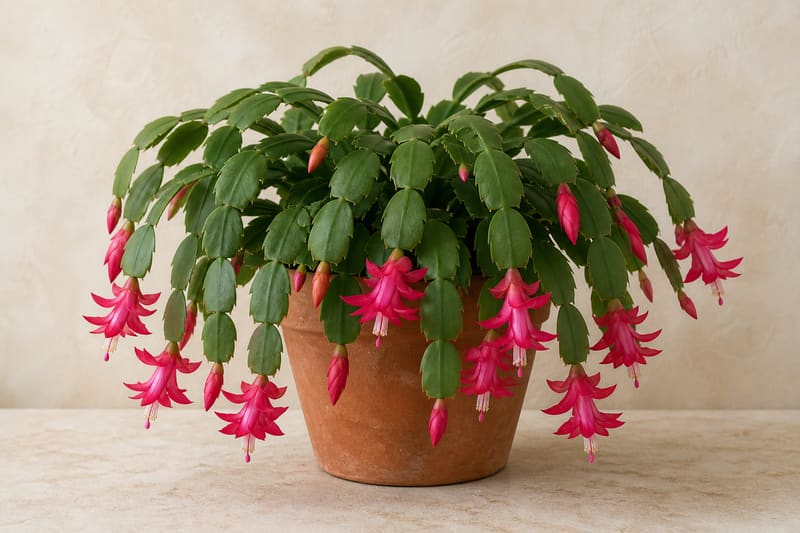
Identify true Christmas Cactus by rounded scalloped stem segments and drooping winter flowers, then coordinate filtered light, airy roots, and seasonal bloom cues.
Light
bright filtered or indirect
Water
water thoroughly after the upper root zone dries
Soil
Airy and draining
Temperature
stable frost-free warmth for growth with cooler safe nights used during flower induction
Plant dossier
Plant overview
Schlumbergera × buckleyi is the true Christmas Cactus, an artificial hybrid in Cactaceae. It carries flattened segmented stems rather than ordinary leaves and grows as a trailing epiphytic houseplant. Its parent species come from the humid forests of southeastern Brazil, so its root-zone behavior differs sharply from a desert cactus.
Plant identification
Botanical characteristics
- Family
- Cactaceae
- Native range
- Artificial hybrid of Schlumbergera russelliana and Schlumbergera truncata, whose parent species come from southeastern Brazil
- Growth habit
- trailing epiphytic hybrid cactus grown as a flowering houseplant
- Care level
- moderate because healthy growth and reliable reblooming require different seasonal cues
- Common names
- Christmas Cactus, True Christmas Cactus, Holiday Cactus
- Propagation
- Stem-segment cuttings after flowering
- Pet safety
- ASPCA lists Christmas Cactus as non-toxic to dogs, cats, and horses
- Scientific synonyms
- Epiphyllum × buckleyi, Schlumbergera bridgesii
Look for broad green segments joined end to end, with rounded or gently scalloped margins rather than pronounced claw-like teeth. Flowers form at the tips and tend to hang downward. Many plants sold as Christmas Cactus are actually S. truncata, the Thanksgiving Cactus, so a holiday label or bloom date alone does not resolve identity.
Before you choose
Is this plant a good fit?
A good fit for
- Bright filtered indoor positions
- Growers interested in seasonal flowering
- Hanging or trailing displays
- Homes needing a pet-safer documented option
Think twice if
- Hot direct-sun windows
- Continuously wet pots
- Rooms with unavoidable autumn night lighting
- Growers expecting desert-cactus care
Care foundation
Care summary
Coordinate bright filtered light, an airy root zone, evidence-based watering, active-season feeding, long uninterrupted autumn nights, cooler safe induction conditions, and a stable location after buds form.
Detailed care
Read the conditions, not a calendar
Light
Use bright indirect or filtered light. Harsh sun can bleach or redden exposed stems, but very dim conditions weaken growth and flowering. During induction, darkness must be genuinely uninterrupted by room lamps; once buds form, return to stable bright filtered daytime light without repeated rotation.
Watering
Water across the root ball when the upper zone has dried and the deeper medium is no longer saturated, then empty runoff. Do not keep roots continuously wet or impose the prolonged bone-dry cycle used for a desert cactus. A flowering plant should not swing abruptly from severe drought to saturation.
Soil and pot
Use a loose well-drained medium with enough organic moisture retention for fine epiphytic roots and enough coarse structure for rapid air return. A modest pot with open drainage is safer than an oversized decorative container. Support the trailing crown when handling.
Temperature and humidity
Stable household warmth supports growth, while cooler safe conditions and long nights help initiate flowers. Protect buds from cold drafts, hot vents, severe drying, and relocation. Humid air can suit the plant, but misting does not correct saturated roots or insufficient night length.
Getting established
Your first 30 days
- 01
Days 1–3: confirm rounded segment identity, drainage, root-zone moisture, buds, and nighttime lighting.
- 02
Week 1: preserve the current orientation and learn one moisture cycle without forcing a desert-style dry-down.
- 03
Week 2: map direct sun, vents, cold glass, and any evening lamps near the plant.
- 04
Weeks 3–4: make one evidence-based correction and judge plump new tips or stable buds.
Growth and maintenance
Support the way it grows
Growth expectations
- New flattened segments extend from terminal joints
- Mature chains arch and trail over the pot
- Flowers form at segment tips after suitable seasonal cues
Seasonal changes
- Spring and summer favor new segment growth
- Autumn long nights and cooler conditions induce buds
- Flowering plants need stable moisture and position
- Post-flowering growth slows temporarily
Common mistakes
- Confusing Thanksgiving Cactus with true Christmas Cactus
- Treating it like a desert cactus
- Moving a heavily budded plant
- Using fertilizer instead of a long-night induction period
Read the plant
Growth signals and practical checks
Healthy growth
- Plump green rounded segments
- Firm rooted crown
- Predictable drainage without prolonged saturation
- Stable terminal buds in the appropriate season
Warning signs
- Wrinkled stems above wet mix
- Repeated bud drop
- Brown soft roots
- Rapid joint loss
Common mistakes
- Confusing Thanksgiving Cactus with true Christmas Cactus
- Treating it like a desert cactus
- Moving a heavily budded plant
- Using fertilizer instead of a long-night induction period
Practical notes
- Identify holiday cacti from segment margins before diagnosing bloom timing
- Mark one terminal segment to compare growth and buds without repeatedly handling the crown
Safety
Toxicity and safety
ASPCA lists Christmas Cactus as non-toxic to dogs, cats, and horses. Non-toxic does not mean that chewing plant material or potting mix is desirable; contact a veterinarian if an animal becomes unwell.
Observation
Problems and observation
Check first
Bud drop, wrinkling, yellow or red stems, drooping, and detached segments are observations, not automatic diagnoses. Map the affected joints, check root-zone moisture and roots, and record recent movement, night lighting, direct sun, temperature, and pest evidence.
Safe next action
Photograph the same side monthly and mark one terminal segment. Record whether the pot was moved, whether nighttime lights were used, when the upper mix dried, and whether new tips or buds remained plump. This separates a care response from normal seasonal change.
04Open a related diagnosis
Frequently asked questions
How is true Christmas Cactus different from Thanksgiving Cactus?
True Christmas Cactus has more rounded scalloped stem margins and generally drooping flowers; Thanksgiving Cactus has more pointed claw-like margins and is commonly sold under the Christmas name.
Is Christmas Cactus a desert cactus?
No. Schlumbergera are rainforest epiphytes, so their fine roots need an airy but not chronically bone-dry medium.
Is Christmas Cactus safe for cats and dogs?
ASPCA lists it as non-toxic to cats and dogs, although chewing any plant material may still cause digestive upset.
Why does a healthy Christmas Cactus fail to bloom?
Interrupted long nights, warm conditions, wrong seasonal timing, or plant stress can prevent bud formation.