
Plant profile
Araucaria heterophylla
Norfolk Island Pine
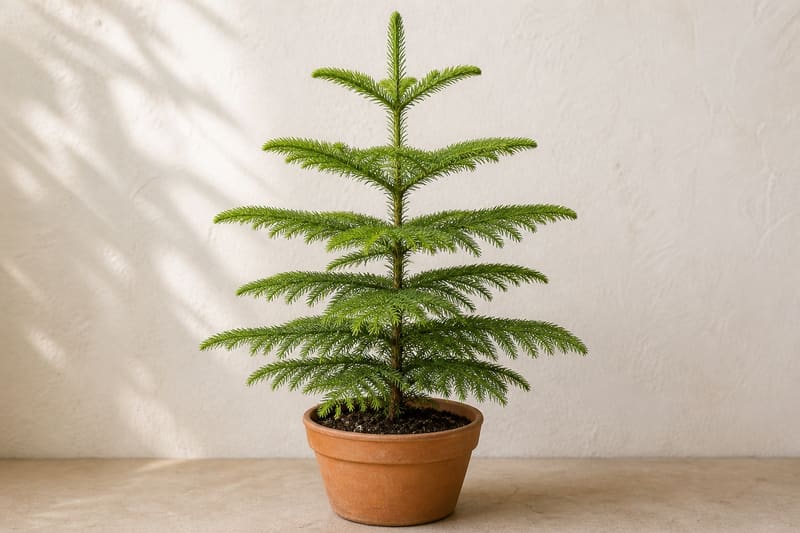
Identify Norfolk Island Pine by its single central leader, regular horizontal branch whorls, and soft juvenile foliage, then coordinate bright light, even moisture, humidity, conservative pruning, and safe holiday display.
Light
Bright indirect or filtered light with gradual acclimation to direct exposure and deliberate rotation for balanced tiers
Water
Let upper mix dry
Soil
Moisture-retentive but freely draining houseplant mix in a proportional container with an unobstructed drain
Temperature
Warm, draft-free
Plant dossier
Plant overview
Norfolk Island Pine is Araucaria heterophylla, an accepted tropical conifer in Araucariaceae native to Norfolk Island, including Philip Island. Despite its common name and holiday silhouette, it is not a true pine in Pinaceae.
Plant identification
Botanical characteristics
- Family
- Araucariaceae
- Native range
- Norfolk Island, including Philip Island
- Growth habit
- evergreen tropical coniferous tree with one upright leader, regular horizontal branch whorls, and soft juvenile awl-like foliage
- Care level
- Moderate because its tiered form depends on strong balanced light, consistent but aerated root moisture, adequate humidity, stable warmth, and protection of the central leader
- Common names
- Norfolk Island Pine, Norfolk Pine, House Pine, Australian Pine, Star Pine, Living Christmas Tree
- Propagation
- Fresh seed, Upright terminal shoot cuttings under specialist conditions
- Pet safety
- ASPCA lists Australian Pine, Araucaria heterophylla, as non-toxic to dogs, cats, and horses; prevent chewing and seek veterinary advice if an animal develops symptoms after ingestion
- Scientific synonym
- Araucaria excelsa
Look for one vertical central leader with horizontal branches arranged in orderly whorls around the trunk. Young indoor plants carry soft bright-green awl-like foliage along fine branchlets. The tiers remain the most useful identification and condition map.
Before you choose
Is this plant a good fit?
A good fit for
- Bright rooms with space for a symmetrical upright tree
- Growers who monitor moisture and winter humidity
- Light seasonal display without heavy ornaments
Think twice if
- Dark corners
- Cold entryways
- Pots without drainage
- Owners wanting frequent shaping or a compact topped tree
- Heavy holiday decorations
Care foundation
Care summary
Coordinate strong filtered light, consistent but aerated root moisture, stable warmth, winter humidity support, restrained feeding during active growth, deliberate rotation, and very conservative pruning.
Detailed care
Read the conditions, not a calendar
Light
Use a bright indoor position and acclimate any direct sun gradually. Photograph the leader orientation, mark the window side of the pot, and rotate by consistent modest increments. Random turning makes the next whorl difficult to interpret.
Watering
Let the upper zone begin to dry while deeper mix retains some moisture, then wet the occupied roots evenly and remove runoff. A dry room does not justify keeping roots saturated, and a drooping tree above a heavy pot requires inspection rather than more water.
Soil and pot
Use a moisture-retentive but freely draining indoor mix in a proportional container with an unobstructed outlet. Keep the trunk at its established depth, preserve firm anchorage, and never use excess wet soil volume merely to counterbalance the canopy.
Temperature and humidity
Keep the tropical tree away from cold panes, exterior doors, radiators, and forced-air outlets. Heated winter rooms can dry fine tips even as lower light slows root water use, so solve foliage humidity and pot moisture as separate variables.
Getting established
Your first 30 days
- 01
Days 1–3: confirm Araucaria heterophylla; photograph the single leader, each branch whorl, trunk base, roots, pot, and window orientation.
- 02
Week 1: verify drainage, map direct rays and drafts, measure winter humidity, and record pot weight plus deeper moisture.
- 03
Week 2: learn one complete watering and drainage cycle without feeding, pruning, repotting, or decorating.
- 04
Weeks 3–4: make one supported adjustment and judge the leader tip, retained tiers, root anchorage, and next dry-down.
Growth and maintenance
Support the way it grows
Growth expectations
- One central leader extends vertically
- Horizontal branches form regular whorled tiers
- Juvenile indoor foliage remains soft and awl-like
- Lost lower branches do not reliably refill
Seasonal changes
- Lower winter light slows extension and water use
- Indoor heating can dry branch tips
- Holiday relocation changes light temperature and drainage
- Brighter warm periods accelerate leader growth
Common mistakes
- Treating it as a cold-hardy true pine
- Topping the leader
- Watering by weekly calendar
- Leaving runoff in holiday foil
- Hanging heavy ornaments
- Rooting a horizontal branch and expecting an upright tree
Read the plant
Growth signals and practical checks
Healthy growth
- Upright intact leader
- Flexible evenly green branch tips
- Balanced tier spacing
- Firm anchored roots
- Predictable root-zone moisture use
Warning signs
- Leader damage
- Repeated tier loss
- Persistent wilt above wet mix
- Loose trunk and soft roots
- Spreading scale or webbing
Common mistakes
- Treating it as a cold-hardy true pine
- Topping the leader
- Watering by weekly calendar
- Leaving runoff in holiday foil
- Hanging heavy ornaments
- Rooting a horizontal branch and expecting an upright tree
Practical notes
- Photograph every whorl from the same angle
- Mark the leader to measure true growth
- Rotate consistently rather than randomly
- Protect structural branches because gaps may remain
Safety
Toxicity and safety
ASPCA lists Australian Pine, Araucaria heterophylla, as non-toxic to dogs, cats, and horses. Non-toxic does not mean edible; prevent chewing and contact a veterinarian if an animal develops symptoms after ingestion.
Observation
Problems and observation
Check first
Read symptoms vertically by leader, newest whorl, lower tiers, trunk base, and roots, then horizontally by room direction. That map separates local branch injury and one-sided light from a whole-root-zone or temperature problem.
Safe next action
Mark the leader tip, photograph every whorl from the same two angles, record the window side of the pot, compare drained weight, and note deeper moisture. Change one supported variable and judge the next extension rather than expecting old gaps to close.
04Open a related diagnosis
Frequently asked questions
Is Norfolk Island Pine a true pine?
No. Araucaria heterophylla belongs to Araucariaceae, not Pinaceae, and it is a tropical tree native to Norfolk Island.
Can I cut the top to keep it short?
Do not top the single central leader; that can permanently spoil the characteristic upright form.
Can I propagate a side branch?
A horizontal lateral cutting retains sideways growth; seed or suitable upright terminal material is required for normal vertical form.
Is Norfolk Island Pine toxic to pets?
ASPCA lists Araucaria heterophylla as non-toxic to dogs, cats, and horses, but chewing can still cause nonspecific stomach upset.