
Plant profile
Ceropegia woodii
String of Hearts
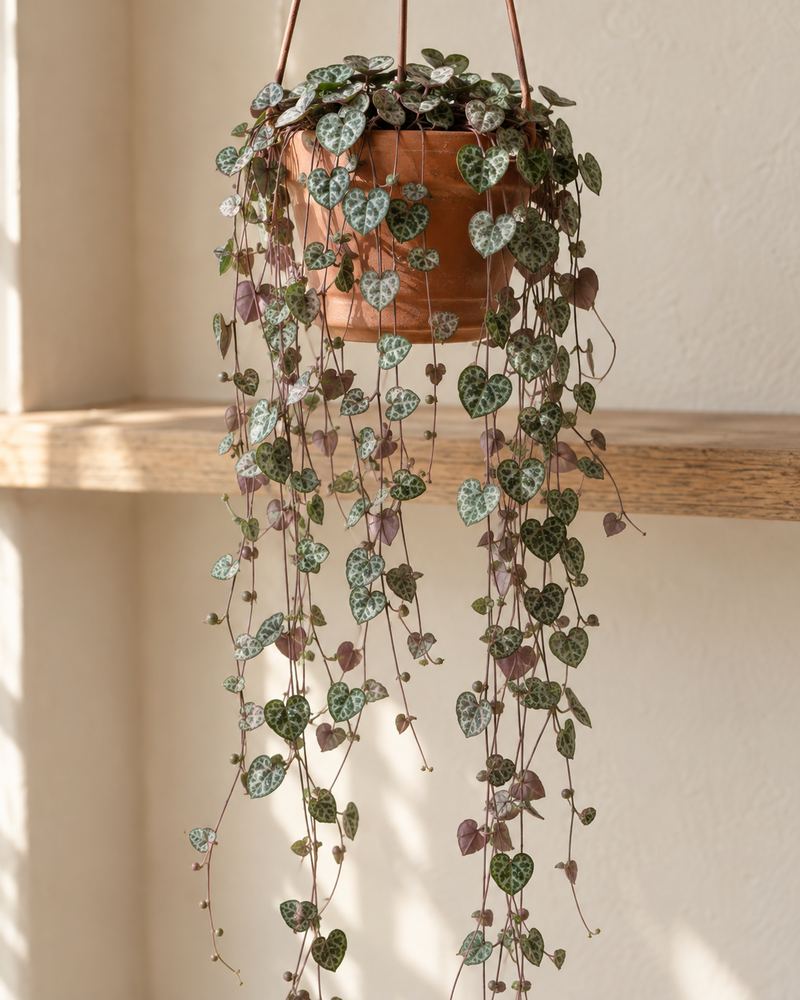
Identify String of Hearts by paired heart-shaped silver-marbled leaves, purple undersides, slender trailing stems, and beadlike aerial tubers, then coordinate crown light, dry-down, drainage, pruning, and node propagation.
Light
bright indirect light across the crown and trails, with gentle direct sun introduced gradually
Water
Let root zone dry
Soil
free-draining cactus or succulent medium with durable mineral structure in a modest pot with an open drain
Temperature
Warm, draft-free
Plant dossier
Plant overview
String of Hearts is a trailing tuberous member of the dogbane family, native from Zimbabwe to South Africa. Kew accepts Ceropegia woodii; horticultural references may also use Ceropegia linearis subsp. woodii.
Plant identification
Botanical characteristics
- Family
- Apocynaceae
- Native range
- Zimbabwe to South Africa
- Growth habit
- trailing tuberous geophyte with paired succulent leaves and node-borne aerial tubers
- Care level
- moderate; tolerant of measured dry-down but vulnerable to a shaded crown, prolonged saturation, and damage to fine tangled vines
- Common names
- String of Hearts, Chain of Hearts, Rosary Vine, Hearts Entangled, Sweetheart Vine
- Propagation
- Stem cuttings with viable nodes, Layering node-bearing vines on the potting surface, Planting firm aerial tubers with attached viable stem
- Pet safety
- No project-approved veterinary source confirms household safety; keep vines and fallen plant material inaccessible and contact a veterinarian after concerning ingestion
- Scientific synonym
- Ceropegia linearis subsp. woodii
Confirm paired heart-shaped leaves with silver-gray marbling above and purple coloring beneath, carried on thin wiry trailing stems. Mature nodes may produce firm beadlike aerial tubers. These integrated storage organs are normal anatomy, not automatically scale insects, eggs, or rot.
Before you choose
Is this plant a good fit?
A good fit for
- Bright shelves or hanging positions where light reaches the crown
- Growers comfortable checking dry-down instead of using a calendar
- Displays where long delicate vines can hang without repeated handling
Think twice if
- Dark shelves that shade the pot top
- Containers without drainage
- Frequent calendar watering
- Positions where children or pets can reach trailing vines
Care foundation
Care summary
Coordinate bright crown light, substantial but non-destructive dry-down, an airy root zone, prompt drainage, warm stable conditions, selective pruning, and node-aware propagation. Read the plant from connected evidence rather than one leaf.
Detailed care
Read the conditions, not a calendar
Light
Bright indirect light should reach the pot top as well as the hanging vines. Introduce direct sun gradually. Compare four consecutive new internodes: widening spacing and smaller new hearts indicate current light limitation more reliably than the length of old vines.
Watering
Combine pot weight, deeper moisture, leaf firmness, root condition, and tuber firmness. Water the occupied root zone thoroughly when demand is confirmed, drain it completely, and avoid leaving runoff trapped around a small tuberous root system.
Soil and pot
Use a modest draining pot and a structurally open cactus or succulent medium. Large unused soil volumes remain wet longer than fine roots can use them. Keep leaves above the surface while allowing selected viable nodes to contact mix for layering.
Temperature and humidity
Protect the plant from frost, cold drafts, and intense heat at glass. Ordinary household humidity with gentle air exchange is usually more useful than misting. High humidity does not compensate for a saturated root zone or a shaded crown.
Getting established
Your first 30 days
- 01
Days 1–3: confirm Ceropegia woodii from paired heart-shaped marbled leaves, photograph the crown and three marked vines, identify normal aerial tubers, inspect pests, and verify drainage.
- 02
Week 1: map light at the pot top, direct-sun boundaries, hanger security, pet and child access, existing leaf loss, and crown firmness.
- 03
Week 2: learn pot weight, deeper moisture, leaf firmness, tuber condition, and drain time without feeding or repotting automatically.
- 04
Weeks 3–4: make one supported adjustment and judge later paired leaves and node spacing rather than old permanent damage.
Growth and maintenance
Support the way it grows
Growth expectations
- Paired heart-shaped leaves form sequentially on slender trailing stems
- Firm aerial tubers may develop at mature nodes
- Nodes can root where they contact suitable medium
- Bright crown light supports compact new spacing
Seasonal changes
- Warm bright growth increases water use
- Cooler lower-light periods extend dry-down
- Abrupt hot sun can scorch previously shaded leaves
- Flowering may occur without changing the basic root-zone decisions
Common mistakes
- Watering by calendar
- Confusing normal aerial tubers with pests or rot
- Lighting the hanging trails while the crown stays shaded
- Burying leaves or using a deep moisture-retentive pot
Read the plant
Growth signals and practical checks
Healthy growth
- Firm paired hearts with clear silver marbling
- Flexible living vines connected to a firm crown
- Compact new node spacing
- Firm basal and aerial tubers
- Functional pale roots
Warning signs
- Dark soft crown tissue
- Persistent wetness with failed roots
- A spreading dry boundary on one vine
- Confirmed cottony insects at nodes
- Concerning child or pet ingestion
Common mistakes
- Watering by calendar
- Confusing normal aerial tubers with pests or rot
- Lighting the hanging trails while the crown stays shaded
- Burying leaves or using a deep moisture-retentive pot
Practical notes
- Measure four consecutive new internodes to read current crown light
- Map normal firm aerial tubers before diagnosing beadlike structures
- Layer viable nodes onto the pot surface to rebuild sparse crown coverage
Safety
Toxicity and safety
No project-approved veterinary source confirms household safety. Keep the long vines and fallen cuttings inaccessible to children and pets, wash after handling damaged material, and contact a veterinarian after concerning ingestion rather than relying on an unverified web claim.
Observation
Problems and observation
Check first
Map each change to the crown, one vine, an exposure side, the whole plant, or the roots. Record moisture duration, leaf firmness, internode spacing, stem continuity, tuber texture, and confirmed insects before choosing a diagnosis.
Safe next action
Photograph the pot top, three marked vines, newest paired leaves, basal tubers, any aerial tubers, the container, and the exposure side. Record pot weight, moisture depth, drain time, crown light, four-node spacing, leaf firmness, and pest evidence.
04Open a related diagnosis
Frequently asked questions
Are the small beads on String of Hearts roots or pests?
Firm beadlike structures integrated with a living node can be normal aerial tubers; inspect for cottony insects, softness, and tissue damage before removing them.
Is String of Hearts the same as String of Pearls?
No. String of Hearts is Ceropegia woodii with paired heart-shaped leaves, while String of Pearls is Curio rowleyanus with spherical leaves.
Can one detached heart-shaped leaf grow a complete plant?
Use a healthy stem section with viable nodes or a firm aerial tuber with attached viable stem rather than relying on one detached leaf.
Is String of Hearts safe for pets?
This project does not have an approved veterinary source confirming safety, so keep the plant inaccessible and contact a veterinarian after concerning ingestion.