
Plant profile
Curio rowleyanus
String of Pearls
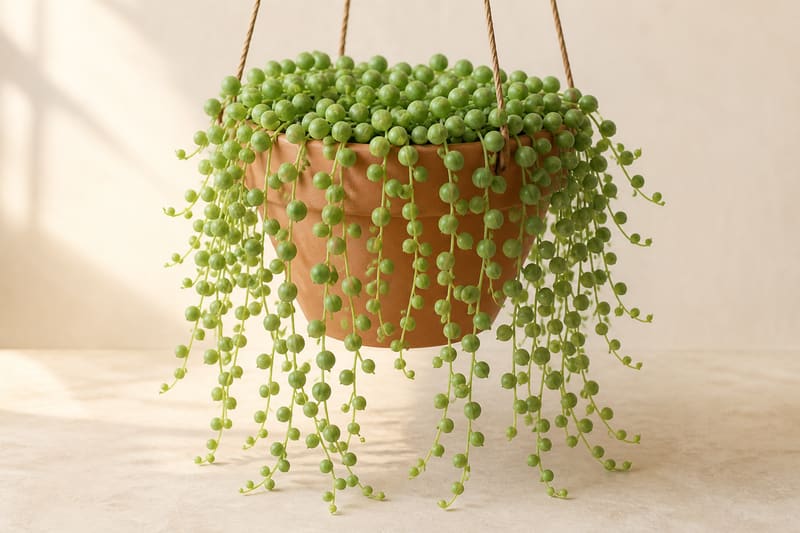
Identify Curio rowleyanus by spherical windowed succulent leaves on trailing stems, then coordinate crown light, substantial dry-down, fast drainage, node propagation, and safe placement.
Light
bright indirect light across both the crown and trails, with only gradual acclimation to gentle direct sun
Water
Let root zone dry
Soil
freely draining peat-free cactus or succulent medium with durable mineral structure in a modest shallow draining pot
Temperature
Warm, draft-free
Plant dossier
Plant overview
String of Pearls is a South African trailing succulent in the daisy family, grown for strings of round water-storing leaves. Kew accepts Curio rowleyanus; Senecio rowleyanus remains a common synonym in horticulture.
Plant identification
Botanical characteristics
- Family
- Asteraceae
- Native range
- Cape Provinces of South Africa
- Growth habit
- trailing evergreen succulent with spherical leaves and rooting stem nodes
- Care level
- moderate; straightforward in bright light and airy mix but sensitive to prolonged saturation and a shaded crown
- Common names
- String of Pearls, String of Beads, String of Peas, Bead Plant, Rosary Vine
- Propagation
- Stem cuttings with viable nodes, Layering healthy strings across the soil surface, Division of rooted crown sections
- Pet safety
- ASPCA reports that ingestion can cause stomach upset, predominantly vomiting, and lethargy in pets; keep the plant inaccessible and contact a veterinarian after concerning exposure
- Scientific synonyms
- Senecio rowleyanus, Kleinia rowleyana
Look for thin creeping or trailing green stems carrying alternate spherical leaves, each with a small pointed tip and a narrow translucent longitudinal window. The plant may root where nodes contact the ground or potting mix.
Before you choose
Is this plant a good fit?
A good fit for
- Bright shelves or hanging positions that illuminate the crown
- Growers comfortable checking dry-down rather than using a calendar
- Displays that keep trails out of reach
Think twice if
- Dark shelves where only trails receive light
- Containers without drainage
- Homes where children or pets can reach the pearls
- Growers who mist or water frequently
Care foundation
Care summary
Coordinate useful light across the crown, substantial but not destructive dry-down, a shallow airy root zone, prompt drainage, ordinary low-to-moderate humidity, and careful node-based propagation.
Detailed care
Read the conditions, not a calendar
Light
Bright indirect light should reach the top of the pot as well as the trails. Acclimate gentle direct exposure gradually. Read current light from the newest node spacing and pearl size, not from trail length alone.
Watering
Combine pot weight, deeper moisture, pearl firmness, and leaf-window appearance. Water the occupied zone thoroughly when demand is confirmed, drain completely, and keep runoff and repeated crown wetting out of the cycle.
Soil and pot
Use freely draining peat-free succulent medium in a modest shallow pot with an open drain. A large deep unused soil volume stays wet longer than the fine root system can safely use.
Temperature and humidity
Protect from frost, cold drafts, and concentrated heat at glass. Ordinary household humidity is usually sufficient; crown ventilation matters more than misting a drought-adapted succulent.
Getting established
Your first 30 days
- 01
Days 1–3: confirm Curio rowleyanus from spherical leaves and translucent windows, photograph the crown and trails, inspect nodes and pests, and verify drainage.
- 02
Week 1: map light across the pot top, direct-sun boundaries, pet and child access, existing shrivel, and crown firmness.
- 03
Week 2: learn pot weight, deeper moisture, pearl firmness, and drain time without feeding or repotting automatically.
- 04
Weeks 3–4: make one supported adjustment and judge compact new nodes rather than old damaged pearls.
Growth and maintenance
Support the way it grows
Growth expectations
- New round pearls form sequentially on slender trailing stems
- Healthy nodes root where they contact suitable medium
- Bright crown light supports dense surface growth and compact spacing
Seasonal changes
- Warm bright growth increases water use
- Cooler lower-light periods extend dry-down
- Sudden hot sun can scorch previously shaded pearls
Common mistakes
- Watering by calendar
- Placing the pot where only trails receive light
- Using a deep moisture-heavy container
- Treating every shriveled pearl as proof of dry soil
Read the plant
Growth signals and practical checks
Healthy growth
- Firm spherical pearls with visible translucent windows
- Green flexible but firm stems
- Compact new node spacing
- Functional pale roots
Warning signs
- Dark soft crown stems
- Persistent wetness with failed roots
- Translucent collapsing pearls
- Confirmed cottony insects
- Concerning pet or child ingestion
Common mistakes
- Watering by calendar
- Placing the pot where only trails receive light
- Using a deep moisture-heavy container
- Treating every shriveled pearl as proof of dry soil
Practical notes
- Use the translucent leaf window and node spacing to read current water balance and light
- Lay healthy node-bearing strings across the surface to rebuild a sparse crown
Safety
Toxicity and safety
NC State and RHS document ingestion and sap concerns, and ASPCA reports vomiting and lethargy in pets after ingestion. Keep the hanging trails truly inaccessible and contact a veterinarian after concerning exposure.
Observation
Problems and observation
Check first
Map each change to the crown, one trail, a sun-facing side, the entire plant, or roots. Add pot weight, moisture duration, pearl texture, node spacing, stem continuity, and confirmed pests before acting.
Safe next action
Photograph the pot top, three marked strings, the newest nodes, the longest healthy trail, pot, and exposure side. Record weight, moisture depth, drain time, crown light, node spacing, pearl firmness, temperature, and visible insects.
04Open a related diagnosis
Frequently asked questions
Is String of Pearls the same as Senecio rowleyanus?
Yes. Curio rowleyanus is the accepted name used here, while Senecio rowleyanus remains a widely recognized synonym.
Is String of Pearls toxic to pets?
ASPCA reports stomach upset, predominantly vomiting, and lethargy after ingestion; keep it inaccessible and contact a veterinarian after a concerning exposure.
Why is my String of Pearls bald on top?
The crown may receive less light than the hanging trails and may lack rooted surface nodes; rule out crown rot before layering healthy stems.
Can one detached pearl grow a new plant?
Use a healthy stem section with viable nodes rather than relying on one detached pearl.